
Best Birdhouses That Birds Actually Use
Nine birdhouses for bluebirds, wrens, chickadees, and purple martins compared on entrance size, material, ventilation, cleanout access, and mounting.
 Updated November 1, 2026
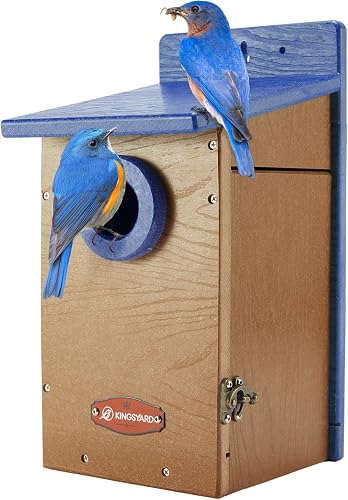
The best birdhouses are built for a particular bird: the entrance hole matches the species, the box sheds rain and lets air move, a door opens for cleaning, and nothing on the front gives a raccoon or cat an easy handhold. Our top pick on those points is the Kingsyard Bluebird House, a recycled poly lumber box whose 1.5-inch entrance and predator guard Kingsyard confirms, with a clear viewing panel inside, according to the Amazon listing. No single house suits every bird, so this guide compares nine houses for bluebirds, wrens and chickadees, and purple martins, and explains what to check before you buy.
We compared the nine on the species each one is built for, entrance size, material, ventilation and drainage, cleanout access, predator protection, and how it mounts. Product specs come from each Amazon listing or the maker’s own product page, and we say which; where the two disagree, we show both. Advice on what makes a good nest box comes from Cornell’s NestWatch program, the North American Bluebird Society, the Purple Martin Conservation Association, and Nebraska Extension, all linked below.
We earn a commission from qualifying purchases made through links on this page. Commissions never affect our rankings or FeederBirdLab Scores.
Our Top Birdhouse Picks
- Best Overall: Kingsyard Bluebird House with Predator Guard. Kingsyard confirms the 1.5-inch entrance, the predator guard, and the vents on its own product page, and the recycled poly lumber body is listed as resisting rot and cracking.
- Best Cedar Bluebird House: Nature’s Way CWH3 Cedar Bluebird Box House. The only bluebird house here listed as cedar, with an extended entrance guard, fledgling kerfs, and an elevated mesh floor, according to the Amazon listing; Nature’s Way’s online store did not list this model number when we checked, so availability may change.
- Best for House Wrens: Kingsyard Hanging Wren House with Metal Predator Guard. Its 1-inch entrance is the smallest here and the size NestWatch gives for House Wrens, with a metal plate around the hole.
- Best Recycled-Plastic Wren House: Kingsyard Recycled Poly Lumber Wren House. The only wren-size house here made of recycled poly lumber, with a 1.1-inch entrance and a side cleanout door, per Kingsyard.
- Best 12-Room Aluminum Martin House: Birds Choice Coates Original Purple Martin House. The only aluminum martin house here with 12 rooms, and Birds Choice includes door plugs for closing the rooms in the off season.
- Best Cedar Wren House: Nature’s Way Cedar Box Wren House. The only wren-size house whose cedar build its maker confirms, with a 1 1/8-inch hole for wrens and chickadees.
- Best Starling-Resistant Martin House: Birds Choice Premium Aluminum Purple Martin House. The only house here with crescent-shaped starling-resistant entrance holes, in eight rooms on two floors.
Two houses carry no title. The Heath M-12DP wooden martin house has a listing that calls the wood redwood in one place and cedar in another and gives 2.75 x 2.75 x 10 inches as the size of a 12-room house, and we found no page for it on Heath’s current website. The Birds Choice recycled poly bluebird house has listing measurements that differ from those on Birds Choice’s own page, and one owner says birds would not nest in the plastic box, though other owners report bluebirds moving in. After Best Overall, the order of the list is not a quality ranking: a house in fourth place is not better than one in eighth, so choose by the bird you want and the features in the table.
Birdhouses Compared
| Birdhouse | Built for | Entrance | Material | Cleanout access | Mounting |
|---|---|---|---|---|---|
| Kingsyard Bluebird House | Bluebirds, chickadees, nuthatches (listing) | 1.5 in round (listing and Kingsyard); reinforced guard (listing) | Recycled poly lumber (listing); recycled plastic (Kingsyard) | Hinged door: the listing says side, Kingsyard says front | Flat surface via two keyholes; pole needs an adapter plate (Kingsyard) |
| Nature’s Way CWH3 | Bluebirds (listing) | Size not listed; extended entrance guard (listing) | Cedar, stainless-steel hardware (listing) | Clean-out door (listing) | Pole or flush mount (listing) |
| Kingsyard Hanging Wren House | House Wrens and other small birds (listing) | 1 in (listing and Kingsyard); metal plate (listing) | Listing says solid cedar; Kingsyard says New Zealand pine | Removable roof held by a metal handle (listing) | Hanging (listing and Kingsyard) |
| Kingsyard Poly Wren House | Wrens, chickadees (listing) | 1.1 in (listing and Kingsyard); reinforced guard (listing) | Recycled poly lumber (listing); recycled plastic (Kingsyard) | Side door (listing and Kingsyard) | Hanging (listing); hanging or freestanding (Kingsyard) |
| Birds Choice Coates Original | Purple martins, 12 rooms on 3 floors | Round holes, door plugs included (Birds Choice) | Aluminum and stainless steel (listing and Birds Choice) | Hinged doors (listing and Birds Choice) | Pole, sold separately (listing); assembly required |
| Nature’s Way Cedar Box Wren House | Wrens, chickadees (listing and Nature’s Way) | 1 1/8 in (listing and Nature’s Way) | Cedar, water-based stain (listing and Nature’s Way) | Clean-out door (listing and Nature’s Way) | Not listed |
| Heath M-12DP | Purple martins, 12 rooms (listing) | Not listed | Listing says redwood in one place, cedar in another | Roof lifts off and dividers lift out (listing) | Pole, sold separately (listing); no assembly required (listing) |
| Birds Choice Premium Aluminum | Purple martins, 8 rooms on 2 floors | Crescent starling-resistant holes (listing and Birds Choice) | Aluminum and stainless steel (listing and Birds Choice) | Hinged doors (listing and Birds Choice) | Pole (Birds Choice); ships unassembled |
| Birds Choice Recycled Bluebird House | Bluebirds (listing and Birds Choice) | 1.5 in with predator guard (listing and Birds Choice) | Recycled poly lumber (listing and Birds Choice) | Two side doors: one for cleaning, one for viewing (Birds Choice) | Post, or pole with a flange (Birds Choice) |
Our ranking reflects our overall assessment of specifications, maker information, and owner reviews. The FeederBirdLab Score is a separate measure based on Amazon customer ratings with a limited editorial adjustment, and it does not set the order.
| Product | FeederBirdLab Score About FeederBirdLab ScoreThe FeederBirdLab Score is our own rating out of 10. It starts from the average Amazon customer rating, may be adjusted by the editor by up to 0.5 points, and is never influenced by brands, retailers, or affiliate commissions. Learn more › | |
|---|---|---|
 Kingsyard Recycled Poly Bluebird House |
8.7/10 | Buy |
 Nature's Way CWH3 Cedar Bluebird Box |
8.9/10 | Buy |
 Kingsyard Hanging Wren House with Metal Guard |
8.6/10 | Buy |
 Kingsyard Recycled Poly Lumber Wren House |
8.7/10 | Buy |
 Birds Choice Coates Original Purple Martin House |
8.4/10 | Buy |
 Nature's Way Cedar Box Wren House |
8.4/10 | Buy |
 Heath M-12DP Wooden Purple Martin House |
8.6/10 | Buy |
 Birds Choice Premium Aluminum Purple Martin House |
8.2/10 | Buy |
 Birds Choice Recycled Poly Bluebird House |
8.2/10 | Buy |
Kingsyard Recycled Poly Bluebird House
A bluebird-size nest box in recycled poly lumber for a post, wall, or fence rather than a hook. According to the Amazon listing, it has a 1.5-inch entrance with a reinforced guard, a clear viewing panel, bottom ventilation holes, and a side opening for cleaning; Kingsyard's own page confirms the 1.5-inch hole and lists 6.3 x 7.6 x 12.2 inches, while the listing also gives a second, different set of dimensions. Owners describe it as sturdy and easy to clean, and one reports bluebirds nesting the first year with no sparrow competition; one owner says it lacks vents near the top and drilled some, and another plans to. Kingsyard calls it a flat-surface mount with two keyholes and suggests an adapter plate or flange for a pole. Look elsewhere if you want a box that bolts straight onto a pole or a larger hole for Western or Mountain Bluebirds.
Pros
- 1.5-inch hole with a reinforced guard, per Kingsyard
- Recycled poly lumber resists rot and cracking, per the listing
- Clear inner panel for nest checks
Cons
- Pole mounting needs an adapter plate or flange
- Owners say it needs more ventilation up high
Nature's Way CWH3 Cedar Bluebird Box
A cedar nest box for bluebirds that mounts on a pole or flush against a flat surface, according to the Amazon listing. The listing describes rot-resistant cedar with stainless-steel hardware, wall and floor air vents, a clean-out door, an elevated galvanized mesh floor to help manage blowfly, a predator guard that extends the entrance hole, and fledgling kerfs inside; it does not state the hole size. Owners report bluebirds nesting in it, and one, who also had a titmouse pair, says the front opens with a small metal clip; one laid plastic canvas over the wire floor after reading complaints about it, and one found squirrels sheltering inside in November. Nature's Way's online store did not list the CWH3 when we checked. Look elsewhere if you need the hole size confirmed before you buy.
Pros
- Extended entrance guard and fledgling kerfs, per the listing
- Wall and floor vents plus an elevated mesh floor
- Front door opens with a metal clip, per one owner
Cons
- Hole size not stated in the listing
- One owner covered the wire floor after complaints
Kingsyard Hanging Wren House with Metal Guard
A small hanging house for House Wrens and other small birds, meant for a branch, hook, or garden structure. According to the Amazon listing, it has a 1-inch entrance with a metal plate around it, corner ventilation holes in the bottom panel, and a removable roof held in place by a metal handle for cleaning out old nests. The listing describes solid cedar, but Kingsyard's own product page describes New Zealand pine, so the wood type is not confirmed. Look elsewhere if cedar is the reason you are buying, or if you want a box for bluebirds, which need a larger hole.
Pros
- 1-inch hole sized for House Wrens, per the listing and Kingsyard
- Metal plate keeps the hole from being enlarged, per the listing
- Removable roof for cleanouts
Cons
- Cedar per the listing but pine per Kingsyard
- Vents listed only in the bottom panel
Kingsyard Recycled Poly Lumber Wren House
A hanging nest box in recycled poly lumber for wrens, chickadees, and other small cavity nesters. According to the Amazon listing, the 1.1-inch entrance is ringed by a reinforced guard meant to keep it from being enlarged, bottom ventilation holes help airflow, and a side door opens for cleanouts; Kingsyard's page confirms the 1.1-inch hole and lists 7.48 x 5.12 x 8.27 inches, while the listing gives two other sets of dimensions. The listing says the recycled poly lumber resists cracking, rotting, and fading. Look elsewhere if you want a wood house or one sized for bluebirds.
Pros
- 1.1-inch hole for wrens and chickadees, per Kingsyard
- Side door for cleanouts
- Resists cracking, rotting, and fading, per the listing
Cons
- Vents listed only in the bottom panel
- Listing gives conflicting dimensions
Birds Choice Coates Original Purple Martin House
A three-floor aluminum house for a purple martin colony, with room for up to 12 nesting pairs, according to the Amazon listing. Birds Choice lists 12 rooms of 6 x 6 x 5.125 inches, round entrance holes, door plugs for closing the house in the off season, hinged doors for cleaning, guard rails, porch dividers, and a reflective roof, and gives 14 x 19 x 20 inches assembled and 8.5 lb. The listing says it requires assembly and that a telescoping pole is sold separately; its weight field reads 0.27 g, which cannot be right. Look elsewhere if you want starling-resistant entrance holes, or if you cannot raise and lower a house on a pole during the season.
Pros
- 12 rooms with door plugs for the off season, per Birds Choice
- Aluminum and stainless steel, light enough to raise and lower, per the listing
- Hinged doors, guard rails, and porch dividers
Cons
- Pole sold separately and assembly required
- Round holes, not a starling-resistant shape
Nature's Way Cedar Box Wren House
A small cedar box for House Wrens and chickadees, Nature's Way model WWTH4 (listed on Amazon under the Wild Wings name). According to the Amazon listing and Nature's Way's own product page, it has a 1 1/8-inch hole meant to keep out sparrows and larger birds, air vents in the walls and floor, a clean-out door, and cedar with a water-based protective stain; Nature's Way lists 8 x 5 x 7 inches and 2 lb. The listing's target species field says cardinal, which conflicts with its own description and with the maker, who lists wrens and chickadees. The listing does not say how it mounts. Look elsewhere if you need a house for bluebirds or want hanging hardware included.
Pros
- 1 1/8-inch hole for wrens and chickadees, per Nature's Way
- Cedar build confirmed by the maker
- Wall and floor vents and a clean-out door
Cons
- Mounting method not listed
- Listing's species field conflicts with the maker's
Heath M-12DP Wooden Purple Martin House
A 12-room wooden purple martin house that needs a pole, sold separately. According to the Amazon listing, the roof lifts off and the room dividers lift out for cleaning, porch rails help keep young birds from falling out, and no assembly is required. The listing contradicts itself on the wood (plantation-grown redwood in the features, cedar in the description) and gives 2.75 x 2.75 x 10 inches as its size; it lists a weight of 10 pounds and a natural wood color, and we found no page for this model on Heath's current website. Look elsewhere if you want a light house for a telescoping pole or a white exterior out of the box.
Pros
- 12 rooms with porch rails, per the listing
- No assembly required, per the listing
- Roof and room dividers lift out for cleaning
Cons
- Listing contradicts itself on wood type and size
- Natural wood finish, not white
Birds Choice Premium Aluminum Purple Martin House
A two-floor aluminum house for a purple martin colony, with crescent-shaped starling-resistant entrance holes. Birds Choice lists eight rooms of 6 x 6 x 5.125 inches, a ventilated roof, hinged doors for cleaning, guard rails, porch dividers, and a reflective roof, and gives 14 x 19 x 14 inches assembled and 6.5 lb; the listing says 7 pounds. Birds Choice and the listing title say it ships unassembled, although one line of the listing description calls it assembled. Neither the listing nor Birds Choice gives the size of the crescent holes. Look elsewhere if you want more than eight rooms or a pole in the box.
Pros
- Crescent starling-resistant entrance holes, per Birds Choice
- Ventilated roof and hinged doors for cleaning
- Aluminum and stainless steel, light enough to raise and lower, per Birds Choice
Cons
- Ships unassembled; the listing includes only the house
- Eight rooms of 6 x 6 inches each
Birds Choice Recycled Poly Bluebird House
A recycled poly lumber bluebird house for a post, or a pole with a flange, made in Wisconsin, according to the Amazon listing. Birds Choice lists a 1.5-inch entrance with a predator guard, an overhang roof, vents and drainage holes, a raised screen floor to reduce blowfly infestations, and two side doors: one for cleaning and one that opens onto plexiglass for viewing. Birds Choice gives 8.75 x 8.5 x 10.75 inches and 6 lb, smaller than the listing's 11 x 8.5 x 12.63 inches. Owners report bluebirds moving in and like the side doors and the roof overhang; one says it came without a hanger, and one says birds in their yard ignore it and nest in cedar boxes instead. Look elsewhere if you prefer wood or want hanging hardware included.
Pros
- Separate doors for cleaning and viewing, per Birds Choice
- Raised screen floor and drainage holes
- 1.5-inch hole with a predator guard
Cons
- No hanger included, one owner says
- One owner says birds preferred cedar boxes
How We Chose
We searched Amazon US for general birdhouses and for houses built for specific cavity nesters (bluebirds, wrens, chickadees, and purple martins), then removed anything that was not a nest box for wild birds. Each remaining house had to be sold new, carry an average of at least 4.0 out of 5 from at least 15 owner ratings, and come from a brand on our reviewed list for this category. Listings whose manufacturer field named a different company than the brand on the label, including retailers, were dropped.
That left more houses than one guide can cover well, so we kept no more than three from any one brand, which left a mix of bluebird, wren, and martin houses. We then read every listing and, where we could match it to the listing’s model number, the maker’s product page, and noted where the two disagree. Several do: one wren house is cedar on Amazon and pine on its maker’s page, and a few listings give weights or sizes that do not match the maker’s figures. Those gaps are in the table above and on each product card.
Best Overall has to be a nest box for common backyard cavity nesters, average at least 4.2 out of 5 from at least 300 owner ratings, come from a brand we have vetted, and still be listed by its maker. The Kingsyard Bluebird House meets all four: Kingsyard’s product page lists the model and confirms the 1.5-inch hole, the predator guard, the ventilation holes, and the recycled plastic body. The Nature’s Way CWH3 also cleared the rating bars, but Nature’s Way’s online store did not list the CWH3 when we checked; it lists a similar cedar bluebird box under a different model number, so we could not confirm the CWH3 is still in production. The other eight are not ranked against one another; their position on the list does not mean one is better than the next. The FeederBirdLab Score on each card is a separate measure and does not decide the order either; see how the score is calculated. Our full method is on the How We Review page.
How to Choose the Best Birdhouses for Your Yard
NestWatch’s checklist of features covers drainage holes, ventilation holes, walls at least 3/4 inch thick, an extended sloped roof, easy access for monitoring and cleaning, rough interior walls, a predator guard, no outside perch, and mounting on a metal pole. Nebraska Extension boils it down to a house that is durable, rainproof, cool, and easy to clean. Use those points, in the order below, to sort the listings.
Start with the species and the entrance hole
Pick the bird first, then check the hole on the listing. NestWatch lists entrance hole sizes by species on its nest box pages, and the North American Bluebird Society’s nestbox factsheet says a 1 1/2 inch round hole works for Eastern Bluebirds while 1 9/16 inch suits all three bluebird species. Here, the two recycled-plastic bluebird houses list 1.5 inches and the CWH3 listing gives no size; the three wren houses list 1 inch, 1.1 inch, and 1 1/8 inch, all below the 1 1/4 inch that NestWatch gives as the smallest hole House Sparrows can use. Kingsyard itself told a buyer that no standard bluebird house is completely sparrow-proof.
Material: wood, recycled plastic, or aluminum
NestWatch prefers untreated wood such as cedar, pine, or fir, and Nebraska Extension says any good, solid, untreated wood is generally the best material, with cedar durable enough that it does not need paint. NABS also lists recycled plastic among materials some bluebird monitors have had success with, and it rules out metal for bluebird boxes because metal severely overheats in hot weather. Purple martin houses are the exception: Nebraska Extension says they are usually lightweight aluminum so the house is easier to raise and lower, and the Purple Martin Conservation Association lists aluminum, thick plastic, wood, and natural gourds as suitable as long as the outside of the house is white.
Among our nine, three small houses are recycled poly lumber, four houses are wood (including the Heath martin house), and the two Birds Choice martin houses are aluminum. Two owners of the Kingsyard Bluebird House say they bought it after wooden boxes wore out; one Virginia owner who has kept bluebird boxes on a farm for more than 25 years expects it to outlast the post it sits on. Wood still has supporters: one owner of the Birds Choice plastic bluebird house says birds in their yard nest in the cedar boxes and ignore the plastic one. The wood itself is not always clear, either. The Kingsyard Hanging Wren House is sold on Amazon as solid cedar, while Kingsyard’s own page describes New Zealand pine. If cedar is the reason you are buying, the Nature’s Way Cedar Box Wren House is the wren-size option whose maker confirms cedar on its product page.
Ventilation and drainage
NestWatch calls for two 5/8 inch ventilation holes near the top of each side wall and at least four drainage holes in the floor (or cut-off floor corners). NABS puts vents high on the sides under the eaves and adds that vent holes can be plugged in very cold or wet weather. Read the listings closely here, because the wording varies. The two Nature’s Way houses list air vents in both the walls and the floor. The three Kingsyard listings describe vents in the bottom panel.
Kingsyard told one buyer the bluebird house’s vents sit under the roof overhang on the sides, yet one owner says it has no vents to keep it from getting too hot and drilled holes near the top of each side, and another plans to add vents because boxes get hot by the third brood in August. Before you drill, note that Kingsyard advised one buyer against drilling an extra hole in this house (for a camera), saying it can affect weather protection and may void the warranty; a shaded spot is the simpler fix.
Floors matter for drainage and for parasites. The CWH3 listing describes an elevated galvanized wire mesh floor that aids in the management of blowfly, and Birds Choice says the raised screen floor in its recycled bluebird house reduces blowfly infestations. One CWH3 owner laid a sheet of plastic needlepoint canvas over the wire floor after reading other owners’ complaints about it, which is worth knowing before you buy.
A door you can open from the side, front, or top
NABS says it is imperative that every nestbox can be opened, that side, front, or roof opening is a matter of preference, and that you should not use a bottom-opening box. Every house here opens somewhere: doors on the bluebird houses, hinged doors on the two Birds Choice martin houses, a removable roof on the Kingsyard Hanging Wren House, a side door on the Kingsyard poly wren house (per Kingsyard’s product page), and a lift-off roof with removable room dividers on the Heath martin house, per its listing. The Kingsyard Bluebird House is described two ways (a side opening in the Amazon listing, a front door with a metal latch in Kingsyard’s answer to a buyer), and one owner describes a side door that opens on a hinge and latches securely. Nebraska Extension notes that a box cleaned out after each brood has fledged may be used again through the summer, so an easy door earns its keep.
Predator guards: what they do and what they do not
Most listings here mention a predator guard, but the term covers different parts. On the small houses it usually means a plate or block around the entrance hole. NABS is direct about its limits: wooden guards over the entry hole are not effective against raccoons, although a wooden guard or metal plate can stop squirrels or woodpeckers from enlarging the hole. NestWatch’s page on predators is more encouraging about thicker guards: it reports that, in research using NestWatch data, nests in boxes with predator guards had success rates 6.7% higher on average, and that cone baffles, stovepipe baffles, and entrance hole extenders were most likely to go with successful nesting. The CWH3 listing describes its guard as one that extends the entrance hole; the Kingsyard listings describe a reinforced guard or metal plate that keeps the hole from being enlarged.
None of these houses comes with a pole baffle, and for climbing predators that is the bigger piece. NestWatch suggests a roof that extends five inches past the front of the box to stop raccoons and cats from reaching in from above, and a baffle on the pole to stop them from climbing up from below. Budget for a baffle if raccoons, cats, or snakes are common where you live.
Mounting: pole, post, wall, or hook
How a house mounts decides where you can put it. NABS recommends a smooth, sturdy pole such as 1/2 to 3/4 inch electrical metal conduit and does not recommend tree trunks, which make a box too easy for climbing predators to reach; Nebraska Extension adds that houses on metal poles are less vulnerable than those on wooden posts or trees. NestWatch’s species pages list a pole for Eastern Bluebirds and purple martins, while House Wren boxes can go on a building, a tree, or a pole. That fits the houses here: the two Kingsyard wren houses are sold for hanging, the CWH3 can be pole or flush mounted, the Birds Choice bluebird house mounts on a post or on a pole with a flange, and the Kingsyard Bluebird House is designed for flat surfaces with two keyholes on the back. For that one, Kingsyard suggests a universal pole-mount adapter plate or flange for 1-inch poles, and one owner fixed a threaded pipe flange to the bottom and set it on a pipe driven into the ground.
Purple martin houses are a bigger commitment
The PMCA says purple martins east of the Rocky Mountains rely almost exclusively on human-provided housing, so a well-chosen martin house matters. It also asks more of you than a bluebird box. Before buying, check that you have an open spot: NestWatch’s purple martin page says there should be no trees or buildings within 60 feet of the martin pole in any direction. The PMCA recommends a height of 12 to 18 feet on a pole that raises and lowers vertically, noting that housing may need to be lowered, sometimes daily, to remove competitor nests and check on the birds. NestWatch gives 10 to 15 feet. None of the three martin houses here includes a pole.
Room count and size come next. The PMCA recommends at least 4 cavities and calls 6 to 12 a great start for a colony, sets the minimum compartment at 6 x 6 inches, and says research has shown that larger 7 x 12 inch compartments offer more protection from predators and weather. Both Birds Choice houses have 6 x 6 inch rooms, per Birds Choice’s pages for the Coates Original and the Premium Aluminum houses, so they meet the minimum rather than the larger size; the Coates page also lists door plugs for closing the house in the off season. The PMCA also says metal or plastic houses with flat, slick floors can leave young martins with permanently splayed legs and recommends textured subfloors; neither Birds Choice listing mentions one, so ask before you buy or plan to add them. For keeping European Starlings out, NestWatch says starling-resistant entrance holes can help, which is the reason to choose the Birds Choice Premium Aluminum house; PMCA describes those holes as 1 3/16 inches tall and 2 3/4 to 3 inches wide, and neither the listing nor Birds Choice’s product page gives the size of its crescents.
The Heath wooden house raises two more questions. Its listing gives a weight of 10 pounds, and Nebraska Extension says wooden martin houses may be too heavy for the telescoping poles often used with aluminum houses; its alternative is a fixed, shorter pole and a ladder for checks. The Heath listing also gives its color as natural wood, while the PMCA, NestWatch, and Nebraska Extension all point to a white exterior for martins, so plan to paint the outside white and leave the interior bare.
Who Should Look Elsewhere
If cardinals are the birds you want, none of these houses will help: the Northern Cardinal is not among the species in NestWatch’s nest box plans, and Audubon’s field guide describes its nest as usually well hidden in dense shrubs, vines, or low trees.
Skip the Kingsyard Bluebird House if you want a box that bolts straight onto a pole with no adapter, or if you live where Western or Mountain Bluebirds nest and want the larger hole NABS prefers for them. Skip the Kingsyard Hanging Wren House if cedar is the reason you are buying it. Skip the martin houses if you cannot keep an open spot 60 feet from trees and buildings or cannot lower the house to check it during the season. And if you would rather build your own and choose the wood thickness and vent layout yourself, NestWatch posts nest box plans by species.
Birdhouse FAQ
Does a birdhouse need a predator guard?
It helps. NestWatch reports that nests in boxes with predator guards did better on average than nests in boxes without them. Know what kind you are getting: an entrance plate mainly stops squirrels and woodpeckers from enlarging the hole, per NABS, while a pole baffle or an entrance extender does more against raccoons and cats.
Does a birdhouse come with a pole or mounting hardware?
Usually hardware, rarely a pole. Kingsyard says its bluebird house comes with the screws needed to mount it, and the two Kingsyard wren houses are sold for hanging. Two of the three martin house listings say the pole is sold separately, and one owner of the Birds Choice recycled bluebird house notes that it came without a hanger. Check the listing for the hardware you need and price a pole and baffle along with the house.
Is a viewing window worth having?
It can make quick nest checks easier. The Kingsyard Bluebird House has a clear inner panel behind its door, and the Birds Choice recycled bluebird house has one side door that opens onto plexiglass for viewing and another for cleaning, per Birds Choice. Kingsyard told one buyer that any nest box can get too hot in direct sun and suggested a shaded or partly shaded spot, away from strong afternoon sun, so a window is not a reason to skip shade or ventilation.
What should I check on an outdoor birdhouse listing before I buy?
Check four lines: the entrance size, the material, which panel opens, and how it mounts. Then compare them with the maker’s own product page when there is one, because listings and makers did not always agree in our research: one wren house is cedar on Amazon and pine on its maker’s page, one bluebird house is described with a side opening on Amazon and a front door by its maker, and several listings give sizes or weights that differ from the maker’s figures. Where the two disagree, we treat the maker’s page as the better source.
Final Thoughts
Choose the bird first, then the hole size, then a house that drains, vents, opens, and mounts the way your yard needs. Where to start for each group:
- Best Overall: Kingsyard Bluebird House with Predator Guard. Plan on an adapter plate or flange if it goes on a pole.
- Best Cedar Bluebird House: Nature’s Way CWH3 Cedar Bluebird Box House. Confirm it is still sold before you count on it, since Nature’s Way’s store did not list the model when we checked.
- Best for House Wrens: Kingsyard Hanging Wren House with Metal Predator Guard. Buy it for the 1-inch hole, not for cedar.
- Best Starling-Resistant Martin House: Birds Choice Premium Aluminum Purple Martin House. Only worth it if you have the open space and a pole that lowers.
For more houses by species and material, browse our Birdhouses section.
About the author

Steve Stephens is an Oregon-based gardener and birdwatcher who has spent seven years creating bird-friendly outdoor spaces. Steve's interests include observing seasonal hummingbird visits, maintaining bird baths, and choosing nest boxes suited to local species. Drawing on a background in garden retail, Steve writes practical guides to hummingbird feeders, bird baths, and birdhouses, with attention to placement, cleaning, and maintenance.