
Best Compact Binoculars for Birding: 9 Small Pairs Compared
Nine compact and pocket binoculars compared on field of view, eye relief, close focus, weight, and weather sealing, with what each small pair gives up.
 Updated November 2, 2026
The best compact binoculars for birding are the ones light enough that you actually take them along, with a field of view wide enough to find a bird before it moves. Our pick is the Nikon Trailblazer 8×25 ATB: per Nikon, it weighs 9.9 oz, shows 429 ft at 1,000 yards, focuses down to 8.2 ft, and is waterproof and fogproof. We compare nine small pairs, from a 21 mm folding pocket model to two 30 to 32 mm midsized ones, and say plainly what each gives up, because every compact binocular trades something for its size.
We compared the nine on the specs that change most when binoculars shrink: field of view, eye relief for eyeglass wearers, close focus for feeder birds, weight and length, and weather sealing. Product specs come from each maker’s own product page where we could open it, linked in the comparison table, and from the Amazon listing otherwise; we say which, and where the two disagree we show both. Buying advice comes from two Audubon magazine articles, linked where we first use them.
We earn a commission from qualifying purchases made through links on this page. Commissions never affect our rankings or FeederBirdLab Scores.
Our Top Compact Binocular Picks for Birding
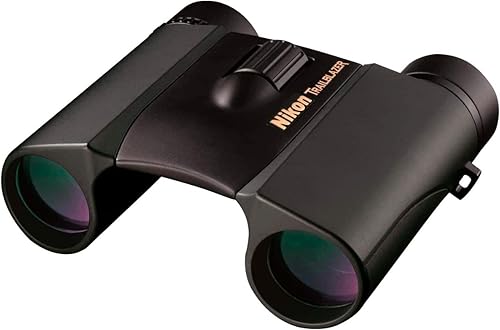
- Best Overall: Nikon Trailblazer 8×25 ATB. A 9.9 oz pocket pair with the second-widest view in this guide, 429 ft at 1,000 yards per Nikon; its 10 mm of eye relief is the catch for eyeglass wearers.
- Best Field of View: Nikon PROSTAFF P3 8×30. The widest view of the nine, 456 ft at 1,000 yards per Nikon, in a 4.9 in, 16.75 oz body.
- Best for Eyeglass Wearers: Celestron Nature DX 8×32. The most eye relief in this guide, 17.5 mm per Celestron, with a 6.5 ft close focus for birds at a nearby feeder.
- Best Close Focus: ZEISS Terra ED Pocket. Focuses down to 6.2 ft per Zeiss, the shortest close focus of the eight pairs with a maker figure, at 10.9 oz.
- Best Lightweight 10x: Nikon ACULON A30 10×25. At 9.7 oz per Nikon, the lightest of the five 10x pairs here, though Nikon’s page gives it no waterproof rating.
Four pairs carry no title. The Leupold BX-1 Rogue 10×25 is short and well sealed, but it has the longest close focus of the pairs with a maker figure. The Vortex Vanquish 10×26 matches the Zeiss on eye relief (16 mm), yet the Zeiss focuses closer and weighs less, per the two makers. The Steiner Safari UltraSharp 10×26 has the widest field of the 10x pairs, 302 ft per Steiner, but only by 8 ft, and its listing gets close focus, exit pupil, and field of view wrong against Steiner’s page. The Bushnell PowerView 2 8×21 has the smallest lenses of the nine, and Bushnell’s US site did not show this model when we checked, so its specs come only from the Amazon listing.
Compact Birding Binoculars Compared
Figures come from each maker’s product page, linked in the first column, unless a cell says listing. Field of view is the width of the scene you see at 1,000 yards. Length is the maker’s first dimension (Vortex calls it height). The last column shows where the Amazon listing gives a different figure for the same model.
| Binocular | Size | Field of view at 1,000 yd | Close focus | Eye relief | Weight | Length | Weather sealing | Where the listing differs |
|---|---|---|---|---|---|---|---|---|
| Nikon Trailblazer 8×25 ATB (Nikon) | 8×25 | 429 ft | 8.2 ft | 10 mm | 9.9 oz | 4.1 in | Waterproof and fogproof; nitrogen filled and O-ring sealed (listing) | None on these specs |
| Nikon ACULON A30 10×25 (Nikon) | 10×25 | 262 ft | 9.8 ft | 13 mm | 9.7 oz | 4.8 in | No rating on Nikon’s page; the listing says waterproof | Weight given as 14.4 oz |
| Nikon PROSTAFF P3 8×30 (Nikon) | 8×30 | 456 ft | 8.2 ft | 15.4 mm | 16.75 oz | 4.9 in | Waterproof to 3.3 ft, fogproof, nitrogen filled | Description gives 19.6 mm of eye relief; its spec field gives 15.4 mm |
| Leupold BX-1 Rogue 10×25 (Leupold) | 10×25 | 294 ft | 14.1 ft | 15 mm | 12.7 oz | 4.3 in | Waterproof and fogproof | Item dimensions given as 9 x 7 in |
| Vortex Vanquish 10×26 (Vortex) | 10×26 | 294 ft | 7.6 ft | 16 mm | 12.7 oz | 4.3 in | Waterproof and fogproof, gas purged | None on these specs |
| ZEISS Terra ED Pocket 10×25 (Zeiss) | 10×25 per the listing (one field says 8x) | 291 ft | 6.2 ft | 16 mm (Zeiss calls it exit pupil distance) | 10.9 oz | 4.4 in | Water resistance rated to 100 mbar, nitrogen filled | Weight given as 1.5 lb (its own description says 10.9 oz); field of view given as 315 ft |
| Steiner Safari UltraSharp 10×26 (Steiner) | 10×26 | 302 ft | 11 ft | 12.66 mm | 10.5 oz | 4.7 in | Waterproof; not nitrogen filled, per Steiner; IPX4 (listing) | Close focus given as 2 m (about 6.6 ft); exit pupil 1 mm (Steiner: 2.6 mm); field of view 330 ft |
| Celestron Nature DX 8×32 (Celestron) | 8×32 | 388 ft | 6.5 ft | 17.5 mm | 18 oz | 5 in | Waterproof, nitrogen filled | Weight given as 1.3 lb (about 20.8 oz); relative brightness 4 (Celestron: 16) |
| Bushnell PowerView 2 8×21 (listing only) | 8×21 | Not confirmed | Not listed | 10 mm (listing) | 272 g, about 9.6 oz (listing) | Not listed | Waterproof (listing) | No maker page found to compare |
Our ranking reflects our overall assessment of specifications, maker information, and owner reviews. The FeederBirdLab Score is a separate measure based on Amazon customer ratings with a limited editorial adjustment, and it does not set the order.
| Product | FeederBirdLab Score About FeederBirdLab ScoreThe FeederBirdLab Score is our own rating out of 10. It starts from the average Amazon customer rating, may be adjusted by the editor by up to 0.5 points, and is never influenced by brands, retailers, or affiliate commissions. Learn more › | |
|---|---|---|
 Nikon Trailblazer 8x25 ATB |
8.8/10 | Buy |
 Nikon ACULON A30 10x25 |
8.6/10 | Buy |
 Nikon PROSTAFF P3 8x30 |
8.7/10 | Buy |
 Leupold BX-1 Rogue 10x25 |
8.9/10 | Buy |
 Vortex Vanquish 10x26 |
8.8/10 | Buy |
 ZEISS Terra ED Pocket |
8.4/10 | Buy |
 Steiner Safari UltraSharp 10x26 |
8.2/10 | Buy |
 Celestron Nature DX 8x32 |
8.2/10 | Buy |
 Bushnell PowerView 2 8x21 |
8.0/10 | Buy |
Nikon Trailblazer 8x25 ATB
A pocket pair for birders who want binoculars on every walk, not just planned outings. Per Nikon, it weighs 9.9 oz, shows 429 ft at 1,000 yards, focuses to 8.2 ft, and is waterproof and fogproof; the Amazon listing says it is nitrogen filled and folds to fit a pocket. Owners praise the size and weight, and one bird-watching couple each carries a pair for unexpected sightings, but three owners say the eyecups do not hold their position and four say the lens caps come off or get lost easily. Look elsewhere if you wear glasses: Nikon lists only 10 mm of eye relief.
Pros
- 9.9 oz and 4.1 in long, per Nikon
- 429 ft field of view at 1,000 yards, per Nikon
- Waterproof and fogproof, per Nikon
Cons
- 10 mm of eye relief, short for eyeglass wearers
- Owners report loose eyecups and lens caps
Nikon ACULON A30 10x25
A very light 10x for birders who want more magnification in a jacket pocket and mostly watch in fair weather. Per Nikon, it weighs 9.7 oz, focuses to 9.8 ft, and shows 262 ft at 1,000 yards, the narrowest field in this guide; this listing is the TrueTimber KANATI camo version. One owner uses it in the yard to watch birds and deer, another says it is not waterproof for harsh weather and may fog, and one owner had to take off their glasses to use it. Look elsewhere if you need a sealed pair: Nikon's page gives it no waterproof rating, although the listing says waterproof.
Pros
- Lightest 10x here at 9.7 oz, per Nikon
- Folding dual-hinge design, per the listing
- 9.8 ft close focus, per Nikon
Cons
- No waterproof rating on Nikon's page
- Narrowest field of view in this guide
Nikon PROSTAFF P3 8x30
A midsized compact for birders who want the widest view in a small body and can carry about a pound. Per Nikon, it shows 456 ft at 1,000 yards, focuses to 8.2 ft, weighs 16.75 oz, and is waterproof to 3.3 ft and nitrogen filled. One owner who wears glasses says it was the first pair they could see through clearly and comfortably, while another, a birding guide, found the image a little cloudy next to a higher Nikon model. Look elsewhere if you want the lightest possible pair: it weighs about 7 oz more than the Trailblazer.
Pros
- Widest field here, 456 ft, per Nikon
- 15.4 mm of eye relief, per Nikon
- Waterproof to 3.3 ft, per Nikon
Cons
- Listing gives two eye relief figures
- One owner finds the image less crisp than a higher Nikon model
Leupold BX-1 Rogue 10x25
A short 10x with a folding inverted Porro prism design, for birders who want a pocket pair with a lifetime guarantee. Per Leupold, it is 4.3 in long, weighs 12.7 oz, gives 15 mm of eye relief, and is waterproof and fogproof. One owner says it fits in a hunting jacket pocket; another notes some vignetting from the small eyepieces and warns that the tight eyepiece cover can pull the eyecup off. Look elsewhere if you watch a feeder near the house: Leupold lists a 14.1 ft close focus.
Pros
- 4.3 in long, per Leupold
- 15 mm of eye relief, per Leupold
- Waterproof and fogproof, per Leupold
Cons
- 14.1 ft close focus, per Leupold
- One owner notes vignetting and a tight eyepiece cover
Vortex Vanquish 10x26
A reverse Porro prism 10x for birders who want a small pair with eye relief that works with glasses. Per Vortex, it weighs 12.7 oz, gives 16 mm of eye relief, focuses to 7.6 ft, and is waterproof and fogproof; the listing says its eyecups twist and lock. The field of view is 294 ft at 1,000 yards, per Vortex, below the 341 ft Audubon's buying guide recommends. Look elsewhere if a wide view matters most: the 8x pairs in this guide see far more of the scene.
Pros
- 16 mm of eye relief, per Vortex
- 7.6 ft close focus, per Vortex
- Waterproof and fogproof, per Vortex
Cons
- 294 ft field of view, per Vortex
- Heavier than the Zeiss and Nikon pocket pairs
ZEISS Terra ED Pocket
A folding pocket pair for birders who watch feeders and garden birds up close. Per Zeiss, the Terra ED Pocket focuses down to 6.2 ft, weighs 10.9 oz, is 4.4 in long, and is nitrogen filled; Zeiss gives 16 mm of exit pupil distance, which the listing labels eye relief. The listing describes the 10x25 version, though one of its fields says 8x, so confirm the magnification before you buy. Look elsewhere if you want a wide field: Zeiss lists 291 ft at 1,000 yards for the 10x25.
Pros
- 6.2 ft close focus, per Zeiss
- 10.9 oz and 4.4 in long, per Zeiss
- 16 mm exit pupil distance, per Zeiss
Cons
- Listing mixes 8x and 10x details
- 291 ft field of view for the 10x25, per Zeiss
Steiner Safari UltraSharp 10x26
A light 10x for birders who mostly look at birds while doing something else, such as hiking or paddling. Per Steiner, it weighs 10.5 oz, shows 302 ft at 1,000 yards, and is waterproof but not nitrogen filled. One birder who owns it says it suits casual birding on walks but lacks good close focus, and another says the diopter setting does not stay put. Look elsewhere if you watch a feeder or wear glasses: Steiner lists an 11 ft close focus and 12.66 mm of eye relief.
Pros
- 10.5 oz, per Steiner
- 302 ft field of view, per Steiner
- Waterproof, per Steiner
Cons
- 11 ft close focus, per Steiner
- Listing gets close focus, exit pupil, and field of view wrong
Celestron Nature DX 8x32
A midsized 8x for eyeglass wearers and backyard birders who watch a feeder close to the house. Per Celestron, it gives 17.5 mm of eye relief, focuses to 6.5 ft, shows 388 ft at 1,000 yards, weighs 18 oz, and has phase-coated BaK-4 prisms. One owner says it solved the problem of a porch too close to a hummingbird feeder, and another says it works well with glasses, though one wishes it were lighter and another finds the eyecups collapse a little. Look elsewhere if it must fit a small pocket: one owner says it does not fit in most purses.
Pros
- 17.5 mm of eye relief, per Celestron
- 6.5 ft close focus, per Celestron
- 388 ft field of view, per Celestron
Cons
- 18 oz, heavier than the pocket pairs
- Listing weight and brightness differ from Celestron
Bushnell PowerView 2 8x21
A small folding roof prism pair for occasional birders who want something for the glove box or a day bag. According to the Amazon listing, it has an aluminum alloy chassis, weighs 272 g (about 9.6 oz), gives 10 mm of eye relief, and is waterproof. Bushnell's US site did not show this model when we checked, so none of these figures are confirmed by the maker. Look elsewhere if you bird in low light or wear glasses: Audubon's buying guide says objectives smaller than 30 mm are not bright enough to show all the detail you need in poor light, and 10 mm of eye relief is short.
Pros
- About 9.6 oz, per the listing
- Folding design for a pocket or glove box
- Aluminum alloy chassis, per the listing
Cons
- 21 mm lenses, under Audubon's 30 mm guideline
- Specs not confirmed on a maker page
How We Chose
We searched Amazon US for compact and small binoculars for birding and for the common small sizes (8×25, 10×25, 8×32), then kept only pairs that their own listing describes as compact, pocket, or small, in the title, the feature bullets, or the listing’s size field. Each pair had to be sold new, average at least 4.0 out of 5 from at least 30 owner ratings, and come from a brand on our reviewed list for binoculars. Two full-size pairs, an 8×42 and a 10×50, turned up in the same searches and came out because they are not compact. We kept no more than three models from one brand, which is why there are three Nikon pairs.
For the top spot we prefer a pair from a brand we have vetted with at least 1,000 owner ratings and an average of at least 4.2. Best Overall goes to the Nikon Trailblazer 8×25 ATB, a pair that met every one of those bars and that Nikon still sells on its own site, listed as waterproof and fogproof. The other eight follow in our research ranking. The FeederBirdLab Score on each card is a separate measure, explained in our scoring method, and does not set the order.
We then opened each maker’s product page and matched it to the listing by model number. Five listings clearly conflict with the maker on the same model: the weight of the ACULON A30, the eye relief of the PROSTAFF P3 8×30 (the listing gives two figures, and Nikon confirms the lower one), the weight of the Terra ED Pocket (Zeiss gives 10.9 oz for both of its pocket sizes), the close focus and exit pupil of the Steiner, and the weight and relative brightness of the Celestron. For each of those we lowered the FeederBirdLab Score by 0.2. Other gaps, such as the item dimensions on the Leupold listing, are shown in the table but did not change a score. Our full method is on the How We Review page.
How to Choose the Best Compact Binoculars for Birding
A search for birding binoculars usually starts with a full-size 8×42. A compact pair answers a different need: the walk where you would otherwise leave binoculars at home, the travel bag, the kitchen windowsill. These points separate the nine pairs above.
Pocket or midsized: the 30 mm line
Audubon magazine’s review of compact and pocket binoculars says definitions vary, but compact binoculars typically have lenses around 32 mm, while pocket binoculars measure 25 mm or under. By that measure, five pairs here are pocket binoculars (21 to 25 mm), two sit just above the pocket line at 26 mm (the Vanquish and the Steiner), and two are midsized compacts: the PROSTAFF P3 8×30 and the Celestron 8×32. We left out one 10×32 that its listing calls compact in one field and mid size in others, because its maker calls it a mid-size design.
The trade-off is light. Audubon magazine’s binocular buying guide says pairs with objectives smaller than 30 mm are lightweight and easy to carry but not bright enough to show all the detail you need in poor light, while midsized 30 to 35 mm models sacrifice a little detail in poor light and make up for it in reduced size and weight. The weight gap is real: the six pairs of 26 mm or less with maker figures run from 9.7 to 12.7 oz, while the two midsized pairs weigh 16.75 oz and 18 oz. If you mostly bird at midday or on a sunny balcony, a small pair gives up little. If you watch a wooded yard at dawn, the extra 4 to 8 oz of a 30 to 32 mm pair buys a brighter view.
Field of view: the 341-foot line
A wide field makes it easier to find a bird and follow it when it flies. Audubon’s buying guide says bird-worthy binoculars should have an angle of view of at least 6.5 degrees, which is 341 ft at 1,000 yards. Only three of the nine clear that line on the maker’s figures: the PROSTAFF P3 8×30 (456 ft), the Trailblazer (429 ft), and the Celestron (388 ft). The other five with maker figures run from 262 ft (ACULON A30) to 302 ft (Steiner), and the Bushnell listing gives no figure we could confirm. The Zeiss figure is for the 10×25 that the listing describes; Zeiss gives the 8×25 version 357 ft, which would clear the line. This is the spec where the nine differ most, and a narrow field is what makes it hard to stay on a warbler moving through leaves.
8x or 10x in a small body
Five of the nine are 10x. Audubon’s buying guide recommends six, seven, or eight power for birding, because higher power also magnifies the shake of your hands, worsens heat shimmer across a field or marsh, and narrows the view. The numbers here follow that pattern: the four 8x pairs include all three that clear the 341 ft line, while the widest 10x here, the Steiner, reaches 302 ft. In a pocket pair, we suggest 8x unless you mostly watch from one spot, such as a deck rail, where you can brace your arms.
Eye relief if you wear glasses
Eye relief is how far behind the eyepiece your eye can sit and still see the whole image, and eyeglass lenses hold the eye farther back. Audubon’s buying guide says binoculars designed for birders offer 15 to 20 mm. Five pairs here meet that range on the maker’s figures: the Celestron (17.5 mm), the Vanquish and the Terra ED Pocket (16 mm each), the PROSTAFF P3 8×30 (15.4 mm), and the Leupold (15 mm). The other four fall below it: the ACULON A30 at 13 mm, the Steiner at 12.66 mm, and the Trailblazer and the Bushnell (listing) at 10 mm. Owners notice the difference. One PROSTAFF P3 owner who wears glasses says that for the first time they could see objects clearly and comfortably, while one ACULON A30 owner had to take their glasses off to use it.
Close focus for feeder and window birds
Close focus is the nearest distance at which the binoculars give a sharp image. If your feeder hangs 8 ft from the window, a pair that cannot focus closer than 14 ft will show only a blur. Per the makers, the range across these nine is wide: 6.2 ft for the Terra ED Pocket, 6.5 ft for the Celestron, 7.6 ft for the Vanquish, 8.2 ft for the Trailblazer and the PROSTAFF P3 8×30, 9.8 ft for the ACULON A30, 11 ft for the Steiner, and 14.1 ft for the Leupold. The Bushnell listing gives no figure. One Celestron owner says it solved the problem of a porch that sat too close to a hummingbird feeder for two other pairs.
Weather sealing
A compact that lives in a jacket pocket or a car will meet rain and sudden temperature changes. Nikon rates the PROSTAFF P3 8×30 waterproof to 3.3 ft and lists the Trailblazer as waterproof and fogproof. Vortex lists the Vanquish as waterproof and fogproof, Leupold says the same of the BX-1 Rogue, and Celestron lists the Nature DX as waterproof and nitrogen filled. Zeiss gives the Terra ED Pocket a water resistance rating of 100 mbar and lists it as nitrogen filled. Steiner lists the Safari UltraSharp as waterproof but not nitrogen filled, and the listing gives it IPX4. Two pairs are weaker on paper: Nikon’s page for the ACULON A30 gives no waterproof rating, and one owner says it is not waterproof for harsh weather and may fog, while the Bushnell’s sealing comes only from its listing.
Small parts that bother owners
Owner complaints about small binoculars often concern eyecups and caps rather than the view. Three Trailblazer owners say the twist-up eyecups do not hold their position, and four say the lens caps come off or get lost easily. One Leupold owner warns that the eyepiece cover fits very tightly and can pull the eyecup off with it. One Steiner owner says the diopter setting does not stay put and the eyepieces take some fiddling to find the right position, and one Celestron owner says the eyecups collapse a little when pressed against the face. None of these rule a pair out, but they matter more on a pair you will carry every day.
Who Should Look Elsewhere
If you will own only one pair and do much of your birding at dawn, dusk, or under heavy woods, a full-size pair is the safer choice; Audubon’s buying guide notes that most experienced birders choose full-size (40 to 45 mm) or midsized (30 to 35 mm) models. If you would rather carry a single small tube and can live with using one eye, a monocular is the other route.
Within this list, eyeglass wearers should skip the Trailblazer and the Bushnell, both at 10 mm of eye relief, and try the Steiner and the ACULON A30 with glasses on before buying. Skip the Leupold if you watch a feeder close to the house; its close focus is the longest of the pairs with a maker figure. Skip the ACULON A30 if your binoculars will ride in a pack through rain. And if you are new to birding, the narrow field of a 10×25 makes birds harder to find; an 8x with a wide field, such as the Trailblazer or the PROSTAFF P3 8×30, is easier to learn on.
Compact Binoculars for Birding FAQ
What are the best compact binoculars for bird watching?
For most birders, a small 8x with a wide field and a sealed body. The Nikon Trailblazer 8×25 ATB fits that at 9.9 oz and 429 ft of view, per Nikon. If you can carry a little more weight, the PROSTAFF P3 8×30 has the widest field here and more eye relief, and the Celestron Nature DX 8×32 is the better choice for eyeglass wearers.
What is the difference between compact and pocket binoculars?
Size of the front lenses, mostly. Audubon magazine’s review says compact binoculars typically have lenses around 32 mm and pocket binoculars 25 mm or under, though definitions vary. Listings use the words loosely: the PROSTAFF P3 8×30 listing calls it compact in its title and full size in its size field, while Nikon shows it alongside its other compact PROSTAFF P3 models.
Are compact binoculars good enough for birding?
In good light, yes. Audubon’s buying guide says pairs under 30 mm are not bright enough to show all the detail you need in poor light, and that midsized 30 to 35 mm models give up only a little. One Trailblazer owner and their spouse, both bird watchers, each carry a pair for unexpected sightings rather than as their main binoculars.
Should I choose 8x or 10x in a compact binocular?
8x for most birders. The three pairs here that clear Audubon’s 341 ft line are all 8x. Choose 10x only if you mostly watch from one spot.
Do I need a waterproof compact binocular?
If it will ride in a pocket, a pack, or a car, it is worth having. Seven of the nine carry a waterproof or water-resistance rating from their maker; Nikon’s page gives the ACULON A30 none, and one owner says it may fog, while the Bushnell’s waterproof claim comes only from its listing.
Final Thoughts
- Best Overall: Nikon Trailblazer 8×25 ATB
- Best Field of View: Nikon PROSTAFF P3 8×30
- Best for Eyeglass Wearers: Celestron Nature DX 8×32
- Best Close Focus: ZEISS Terra ED Pocket
- Best Lightweight 10x: Nikon ACULON A30 10×25
A compact binocular earns its place by being with you when a bird shows up. Start with field of view and eye relief, the two specs where small pairs differ most, then check close focus if you watch a feeder. If your pair will spend its life in a pocket or a car, weather sealing matters more than one more power of magnification. More gear for watching birds is in our Binoculars and Birding Gear section.
About the author

Vicki Armstrong is a Colorado-based nature writer and recreational photographer with eight years of birdwatching experience on local trails and across the western United States. Vicki researches smart bird feeders, binoculars, and birding accessories, focusing on features that help people observe and document birds. Vicki also writes regional identification guides that explain field marks, habitat, seasonal occurrence, and commonly confused species.