
Backyard Birds of the Midwest Identification Guide: 8 States Compared
Identify backyard birds of the Midwest by group, with FeederWatch counts for eight states showing which birds are everywhere and which shift north to south.
 Updated October 29, 2026

Backyard birds of the Midwest identification starts with a short list that holds across the whole region. Comparing Project FeederWatch state reports for eight Midwest states over the most recent complete season, eight species averaged at least half of participating sites in every one of those states: the Downy Woodpecker, Dark-eyed Junco, Northern Cardinal, House Finch, Red-bellied Woodpecker, Blue Jay, American Goldfinch, and White-breasted Nuthatch. Chickadees are widespread as well, but the region is split between two species, and which one you get depends on how far south you live. This guide shows how to sort those birds by group, then where the states differ.
Which States Count as the Midwest Here
Definitions of the Midwest vary. This guide uses the eight states covered by the USDA Midwest Climate Hub: Michigan, Ohio, Wisconsin, Minnesota, Iowa, Missouri, Indiana, and Illinois. Other definitions of the region take in more states; this guide sticks to these eight because each has a FeederWatch state report with enough sites to compare.
The numbers come from the state reports of Project FeederWatch, a November to April count run by Cornell and Birds Canada. For each state, the chart gives the share of reporting sites that logged a species, averaged over the season’s 13 count periods. Sample sizes differ a lot: Ohio had roughly 300 to 500 reporting sites per period, while Iowa had about 45 to 85, so treat the Iowa figures as rougher. Descriptions of each bird draw on the Audubon Guide to North American Birds.
Backyard Birds of the Midwest Identification Chart
| Species (season average, percent of FeederWatch sites) | IL | IN | IA | MI | MN | MO | OH | WI |
|---|---|---|---|---|---|---|---|---|
| Downy Woodpecker | 74 | 80 | 79 | 78 | 80 | 78 | 79 | 78 |
| Dark-eyed Junco | 84 | 79 | 82 | 83 | 78 | 76 | 80 | 83 |
| Northern Cardinal | 85 | 88 | 78 | 82 | 69 | 90 | 90 | 77 |
| House Finch | 80 | 86 | 78 | 66 | 59 | 76 | 80 | 66 |
| Red-bellied Woodpecker | 63 | 70 | 61 | 69 | 57 | 62 | 68 | 66 |
| Blue Jay | 57 | 69 | 65 | 79 | 66 | 64 | 71 | 64 |
| American Goldfinch | 58 | 70 | 54 | 72 | 61 | 66 | 69 | 74 |
| White-breasted Nuthatch | 52 | 66 | 56 | 72 | 68 | 51 | 64 | 68 |
| Black-capped Chickadee | 46 | 20 | 59 | 86 | 87 | 26 | 35 | 87 |
| Carolina Chickadee | 3 | 35 | 0 | 0 | 0 | 22 | 23 | 0 |
| House Sparrow | 90 | 76 | 85 | 58 | 42 | 57 | 75 | 59 |
| Mourning Dove | 76 | 77 | 38 | 74 | 30 | 75 | 74 | 74 |
| Hairy Woodpecker | 30 | 33 | 29 | 43 | 55 | 30 | 37 | 53 |
| Red-breasted Nuthatch | 30 | 19 | 21 | 47 | 34 | 11 | 18 | 46 |
| Tufted Titmouse | 15 | 59 | 14 | 59 | 1 | 60 | 59 | 18 |
| Carolina Wren | 10 | 33 | 5 | 17 | 0 | 43 | 34 | 1 |
| American Robin | 41 | 38 | 34 | 28 | 25 | 46 | 43 | 27 |
| European Starling | 45 | 56 | 41 | 34 | 17 | 49 | 49 | 28 |
| American Tree Sparrow | 13 | 13 | 10 | 24 | 11 | 6 | 13 | 20 |
| Red-winged Blackbird | 28 | 26 | 17 | 21 | 14 | 20 | 28 | 17 |
| Pileated Woodpecker | 1 | 18 | 0 | 14 | 23 | 7 | 9 | 15 |
| Eurasian Tree Sparrow | 6 | 0 | 11 | 0 | 0 | 25 | 0 | 0 |
A season average hides timing. Juncos, for example, are near 0 in summer and close to 100 percent in some winter weeks. FeederWatch also lets counters log “Carolina/Black-capped Chickadee” when they cannot tell the two apart; that category is left out of the chart.
Identify by Group First
In his eight identification clues for Audubon, Kenn Kaufman puts color near the end: start by placing a bird in its group, use shape and size compared with a familiar bird such as a robin, and then check behavior, habitat, season, field marks, and voice. Midwest feeder birds fall into a handful of groups that make this easy.
Black-and-White Woodpeckers on the Suet
Three woodpeckers cover most Midwest suet feeders. The Downy (5 to 7 inches) and the Hairy (7.1 to 10.2 inches) wear the same pattern, a white panel down a black back; the Hairy has a much longer bill relative to its head and unbarred white outer tail feathers. The Red-bellied is different at a glance: its whole back is barred in fine black and white, and the red sits on the head, not the belly. The Downy is the steadiest bird in the region, averaging 74 to 80 percent of sites in every state. If something crow-sized and black with a red crest lands on a dead tree, that is a Pileated Woodpecker, which averaged 14 to 23 percent of sites in Minnesota, Indiana, Wisconsin, and Michigan but 1 percent or less in Illinois and Iowa.
Small Gray Birds: Chickadees, Nuthatches, Titmice, Juncos
Sort these by behavior before plumage. A tiny bird with a black cap and black bib that hangs upside down from twigs is a chickadee. One that creeps headfirst down a trunk is a nuthatch: the White-breasted has a white face, while the smaller Red-breasted has a black eye line and buffy orange belly. A gray bird with a pointed crest and a black forehead is a Tufted Titmouse. A slate-gray bird with a white belly that hops on the ground and flashes white tail edges when it flushes is a Dark-eyed Junco, the “Slate-colored” form that Audubon says is the one usually seen in the East.
Red Birds: Cardinals and House Finches
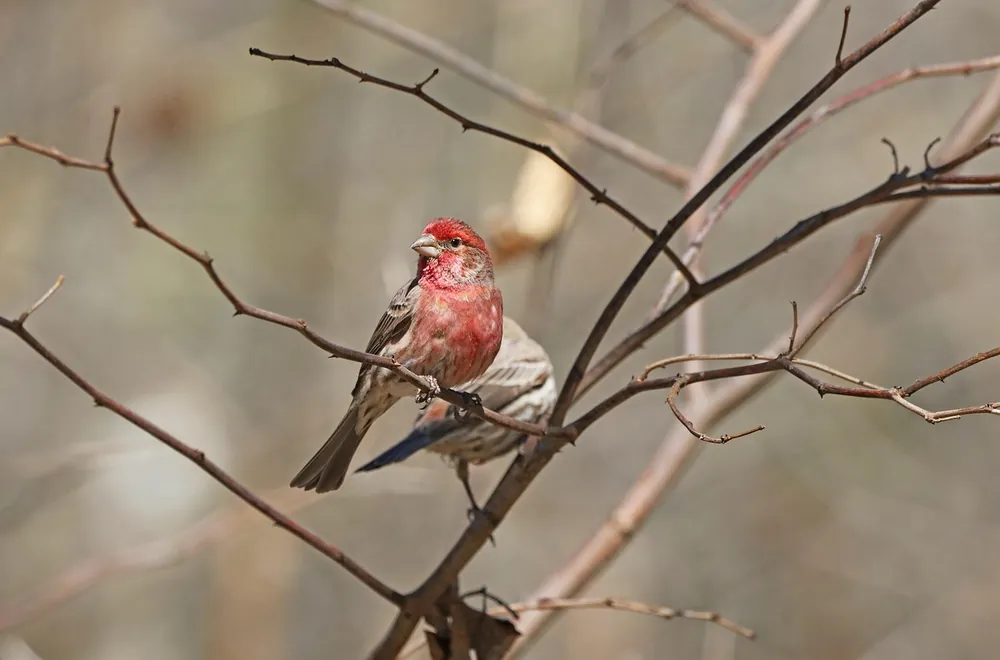
Size and shape split these instantly. The Northern Cardinal is robin-sized, crested, and long-tailed, with a heavy pink bill; females are brownish with the same shape. The House Finch is sparrow-sized with no crest; males show red on the forehead, eyebrow, throat, and chest and dark streaks along the sides, and females are plain-faced and blurry-streaked. A rosier, chunkier finch with no side streaks is likely a Purple Finch. Cardinals averaged 77 to 90 percent of sites in every state except Minnesota, where the figure was 69.
Goldfinches That Are Not Gold
Kaufman uses the goldfinch as his example of why color misleads, and Midwest winters prove the point. The American Goldfinch at a January feeder is dull yellowish brown to gray. Look instead for a small finch with black wings crossed by bold pale bars and white spots in the tail. It averaged 54 to 74 percent of sites across the eight states.
The Big Blue Bird: Blue Jay
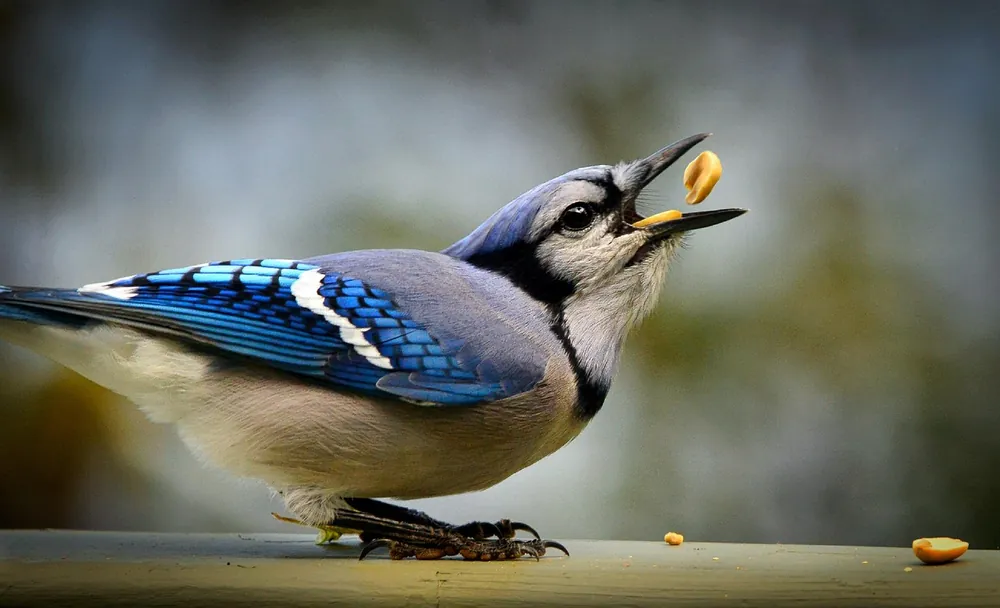
Crested, 9 to 12 inches, bright blue on the wings and tail with a black necklace and white in the wings and tail corners. Audubon notes that bluebirds and buntings are much smaller. Michigan sites logged jays more widely than any other state in the chart, at 79 percent on average.
Ground Feeders: Doves and Sparrows
Check the ground under every feeder. The Mourning Dove is slim and tan with black wing spots and a long, pointed tail. The male House Sparrow has a black bib and a gray crown with chestnut behind it; this introduced bird averaged 85 to 90 percent of sites in Illinois and Iowa. In winter, a sparrow with a rusty cap, a two-toned bill, and a dark spot on a plain chest is an American Tree Sparrow, which Audubon says often feeds with juncos. A brown sparrow with a crisp white throat and a yellow spot before the eye is a White-throated Sparrow.
Lawn Birds and Blackbirds
The American Robin, with its brick-red chest, eats mostly insects, berries, and earthworms, per Audubon, so look for it on the lawn or in fruiting trees rather than at the seed feeder. Three black birds are easy to mix up, and shape sorts them: the European Starling is short-tailed and stocky with a thin, straight bill; the male Red-winged Blackbird shows red shoulder patches edged in yellow; and the Common Grackle is long and glossy with a pale eye and a creased tail.
North and South Differences Across the Region
The region-wide list is the easy part. These patterns in the state reports tell you what to expect in your own corner of it.
- Which chickadee: Black-capped Chickadees averaged 86 to 87 percent of sites in Michigan, Minnesota, and Wisconsin, and Iowa reported no Carolinas. In Indiana, Ohio, and Missouri, Carolina Chickadees made up a large share, and 19 to 28 percent of sites also entered an undecided chickadee. Audubon calls the Carolina nearly identical to the Black-capped, a little smaller, with a neater bib and less white edging on the wings.
- Titmice and Carolina Wrens: titmice averaged 59 to 60 percent of sites in Indiana, Michigan, Ohio, and Missouri, and Carolina Wrens 33 to 43 percent in Indiana, Ohio, and Missouri. Minnesota reported titmice at about 1 percent and Carolina Wrens at 0, and Wisconsin, Iowa, and Illinois were far lower than the southern and eastern states, with titmice at 14 to 18 percent.
- Northern woodpeckers and nuthatches: Hairy Woodpeckers averaged 53 to 55 percent in Wisconsin and Minnesota against about 30 percent in Illinois, Iowa, and Missouri. Red-breasted Nuthatches followed a similar pattern, highest in Michigan and Wisconsin.
- Junco departure: juncos leave the southern states first. In the last count period of April, they were logged at 6 percent of Missouri sites and 9 percent in Indiana, but 55 to 58 percent in Wisconsin and Michigan.
- Winter robins: from December through January, robins stayed at 34 to 40 percent of Missouri sites but fell to 2 to 6 percent in Wisconsin.
- Mourning Doves: averaged about 74 to 77 percent in six states but only 30 percent in Minnesota and 38 percent in Iowa.
State Notes
Each state adds its own twist to the regional list. Blue Jays and Red-breasted Nuthatches are more widespread at Michigan feeders than anywhere else in the chart, and juncos linger there late into April. Ohio counters logged Black-capped Chickadees at 35 percent of sites on average, Carolina Chickadees at 23 percent, and undecided chickadees at 22 percent, so both species are widespread there. Missouri yards near St. Louis host the Eurasian Tree Sparrow, an introduced bird that the Missouri Department of Conservation describes as limited, in North America, to the St. Louis area and nearby parts of Illinois and Iowa; Missouri sites averaged 25 percent for it, and Missouri also kept the most winter robins and Carolina Wrens of the eight states. Wisconsin’s woodpecker numbers stand out, with Hairy and Pileated Woodpeckers both well above the regional middle.
In Illinois, Iowa, Minnesota, and Indiana, the reports show a few clear traits. Illinois and Iowa had the highest House Sparrow figures, at 85 to 90 percent. Minnesota was the most northern in character, with the lowest Mourning Dove, Northern Cardinal, and House Finch averages in the chart and almost no titmice. Indiana had the highest Carolina Chickadee average and an Eastern Bluebird average of 38 percent, close to Missouri’s 40.
Starting Out in a Midwest Yard
Much of how to start bird watching, according to Audubon’s beginner primer, comes down to noticing the birds already around you, and your own yard counts. Audubon adds that binoculars are not required, though they make things easier. To bring more of the regional list into view, Audubon Great Lakes, whose region covers five of the eight states here (all but Minnesota, Iowa, and Missouri), pairs suet with woodpeckers and nuthatches, tube feeders with goldfinches and other small finches, and hoppers with cardinals and Blue Jays, and it recommends keeping seed off the ground and skipping platform feeders, which it says draw crowds of birds and deer. Once the feeder birds are familiar, Kaufman’s season clue becomes useful. Red-winged Blackbirds, for example, were logged at 12 percent of sites or fewer from early December to early February in every state but Missouri, then at 40 to 63 percent from mid-March in the other seven.
Frequently Asked Questions
Which backyard birds live in every Midwest state?
In the most recent complete FeederWatch season, the Downy Woodpecker, Dark-eyed Junco, Northern Cardinal, House Finch, Red-bellied Woodpecker, Blue Jay, American Goldfinch, and White-breasted Nuthatch each averaged at least half of reporting sites in all eight states covered here. Chickadees are also common across the region, split between the Black-capped in the north and the Carolina farther south.
When do juncos leave the Midwest in spring?
It depends on latitude. In early April, Missouri sites were already down to 26 percent while Wisconsin was at 98 percent. By the second half of April, juncos were nearly gone from Missouri and Indiana but still at more than half of Wisconsin and Michigan sites.
Are there birds I will only see in the southern Midwest?
Mostly yes for the Carolina Chickadee, Carolina Wren, and Tufted Titmouse, which were common in Indiana, Ohio, and Missouri counts and scarce or absent in Minnesota. The Eurasian Tree Sparrow showed up only in the Missouri, Illinois, and Iowa reports.
How can I identify a Midwest bird from a photo?
Use the order Kaufman recommends: place the bird in a group by shape, judge its size against a robin or sparrow, then look for one field mark such as bill length, a crest, wing bars, or tail spots. Add the date and your state, which narrow the options quickly.
Final Thoughts
Across the Midwest, the core of a winter feeder list is the same eight species that averaged half of FeederWatch sites in every state, plus whichever chickadee lives in your area. Learn those by group and shape, then let geography fill in the rest: Carolina birds and winter robins to the south, Hairy and Pileated Woodpeckers and lingering juncos to the north. For optics and other equipment that help with field marks, see the Binoculars & Birding Gear section.
About the author

Vicki Armstrong is a Colorado-based nature writer and recreational photographer with eight years of birdwatching experience on local trails and across the western United States. Vicki researches smart bird feeders, binoculars, and birding accessories, focusing on features that help people observe and document birds. Vicki also writes regional identification guides that explain field marks, habitat, seasonal occurrence, and commonly confused species.