
Best Squirrel-Proof Bird Feeders: 5 Picks Compared
Five squirrel-proof bird feeders compared on how they shut out squirrels, weight adjustment, capacity, and upkeep.
 Updated October 27, 2026
The best squirrel proof bird feeder for most backyards is one that physically shuts squirrels out, either with a shroud that drops over the feeding ports under a squirrel’s weight or with a cage that small birds can pass through and squirrels cannot, and that hangs where a squirrel cannot reach it from a pole, trunk, or roof. Our Best Overall pick, the Brome Squirrel Buster Plus, works the first way: Brome lists a 5.1 lb seed capacity, the Amazon listing gives it six feeding ports and a weight-adjustable spring, and Brome still sells it on its own store. The other four feeders cover smaller yards, birders who prefer a cage to a moving part, and a few trade-offs worth knowing before you buy.
We compared all five on how each one keeps squirrels out, whether the closing weight can be adjusted, seed capacity, and how the feeder comes apart for cleaning. Every product spec here comes from the Amazon listing for that exact product or, where we say so, from the maker’s own pages. A feeder rarely settles a squirrel problem on its own, so we also point out where placement matters as much as the hardware.
We earn a commission from qualifying purchases made through links on this page. Commissions never affect our rankings or FeederBirdLab Scores.
Our Top Squirrel-Proof Bird Feeder Picks
- Best Overall: Brome Squirrel Buster Plus. A weight-triggered tube feeder with six ports, an adjustable spring, and a 5.1 lb capacity, the largest among the feeders whose capacity we could confirm.
- Best Small-Capacity Feeder: Brome Squirrel Buster Standard. The same shroud mechanism in a four-port tube that holds 1.3 lb, the smallest capacity among the feeders whose capacity we could confirm.
- Best Caged Feeder for Small Birds: Kingsyard Caged Squirrel-Proof Platform Feeder. The only feeder here that keeps squirrels out with a metal mesh cage instead of a moving part, with 1.5 x 1.5 inch openings, per the listing.
Two feeders carry no title. The Woodlink Absolute II ranks third on our method, and its listing describes steel construction and a closing mechanism that adjusts by weight, but it gives too few confirmed specs for us to call it the best at anything. The Kingsyard weight-activated house feeder ranks fifth: it uses the same idea as the Squirrel Busters in a house-shaped metal body, but its listing describes no weight adjustment, and two owners report the spring mechanism failing.
Squirrel-Proof Bird Feeders Compared
| Feeder | How it keeps squirrels out | Weight adjustment | Seed capacity | Feeding access | Body materials (per listing) | Also listed |
|---|---|---|---|---|---|---|
| Brome Squirrel Buster Plus | Shroud drops over the ports under a squirrel’s weight | Yes, spring mechanism | 5.1 lb (Brome) | 6 ports; Cardinal Ring included | Plastic; parts exposed to squirrels listed as chew proof | 28 in tall with hanger (Brome); pole mount needs an adapter sold separately |
| Brome Squirrel Buster Standard | Shroud drops over the ports under a squirrel’s weight | Yes, spring mechanism | 1.3 lb (Brome) | 4 ports with perches; wire shroud for clinging birds | Plastic; stainless steel perches | 21.5 in tall with hanger (Brome); seed tube ventilation |
| Woodlink Absolute II | Closing mechanism, per the listing | Yes, per the listing | 2 gallon, per the listing (feature text cut off) | Not listed | Steel with polycarbonate windows | Heavy-duty hanger; baffles to reduce wasted seed |
| Kingsyard Caged Platform | Metal mesh cage with 1.5 x 1.5 in openings | Not applicable | About 2.5 lb (Kingsyard; listing gives 1.13 kg) | Open tray inside the cage | Recycled plastic and metal | Metal mesh tray floor; refills from the top |
| Kingsyard Weight-Activated House | Spring lowers a metal shell over the feeding openings | None listed | 5 lb (Kingsyard; listing gives both 3 to 5 lb and 4 lb) | U-shaped perches (Kingsyard); port count not listed | Metal exterior with plastic inner pipes | Lid latches on both sides; drainage holes |
Our ranking reflects our overall assessment of specifications, maker information, and owner reviews. The FeederBirdLab Score is a separate measure based on Amazon customer ratings with a limited editorial adjustment, and it does not set the order.
| Product | FeederBirdLab Score About FeederBirdLab ScoreThe FeederBirdLab Score is our own rating out of 10. It starts from the average Amazon customer rating, may be adjusted by the editor by up to 0.5 points, and is never influenced by brands, retailers, or affiliate commissions. Learn more › | |
|---|---|---|
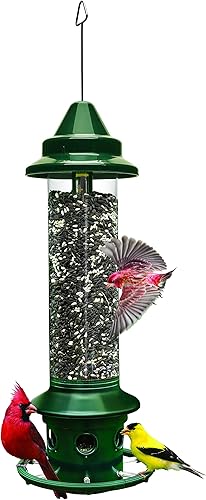 Brome Squirrel Buster Plus Squirrel-Proof Feeder |
8.9/10 | Buy |
 Brome Squirrel Buster Standard Squirrel-Proof Feeder |
8.8/10 | Buy |
 Woodlink Absolute II Squirrel-Resistant Bird Feeder |
8.6/10 | Buy |
 Kingsyard Caged Squirrel-Proof Platform Feeder |
8.3/10 | Buy |
 Kingsyard Weight-Activated Squirrel-Proof House Feeder |
7.9/10 | Buy |
Brome Squirrel Buster Plus Squirrel-Proof Feeder
A large tube feeder for yards with steady squirrel traffic and plenty of birds to feed. According to the Amazon listing, a squirrel's weight pulls the shroud down over the six feeding ports, a spring sets how much weight that takes, the parts exposed to squirrels are chew proof, and the feeder comes apart by hand for cleaning; Brome's own page lists a 5.1 lb seed capacity. Owners on this listing describe squirrels giving up within weeks, and three describe Brome sending replacement parts, though one says the green finish faded within two years. Look elsewhere if you want to hang it from a branch right away: one owner notes it comes without a tree hook, and pole mounting needs an adapter the listing says is sold separately.
Pros
- Shroud closes all six ports under a squirrel's weight, per the listing
- Weight-adjustable spring and Cardinal Ring included
- Owners report Brome sending replacement parts
Cons
- Pole adapter and tree hook not included
- One owner reports the green finish faded; another saw chew marks after three weeks
Brome Squirrel Buster Standard Squirrel-Proof Feeder
A smaller Squirrel Buster for a balcony, a small yard, or light bird traffic. According to the Amazon listing, it uses a weight-adjustable shroud that closes the ports when a squirrel climbs on, has perches for perching birds and a wire shroud for clinging birds, and needs no tools to assemble; Brome's own page lists 1.3 lb of seed and four seed ports. Owners on this listing say squirrels tried and gave up, and one uses it on a balcony. Others say peanut pieces jam where the tube narrows and that seed can bind in the tube's channels. Look elsewhere if many birds visit: one owner empties a full feeder every two days.
Pros
- 1.3 lb seed capacity, per Brome
- Adjustable shroud closes the four ports under a squirrel's weight
- Perches plus a wire shroud for clinging birds
Cons
- Peanut pieces and seed can jam in the tube, owners say
- Needs frequent refills when many birds visit
Woodlink Absolute II Squirrel-Resistant Bird Feeder
A steel-bodied feeder for anyone who prefers a metal weight-triggered design. According to the Amazon listing, it has steel construction with polycarbonate windows, a closing mechanism that adjusts by weight, baffles meant to reduce wasted seed, and a heavy-duty hanger. The listing's feature text describes a large 2-gallon capacity and its title includes 12 lbs, but the listing does not state the number of feeding ports, and Woodlink's website blocked our requests, so we could not confirm these figures with the maker. Look elsewhere if you want the capacity and port layout confirmed by the maker before you buy.
Pros
- Steel construction with polycarbonate windows, per the listing
- Closing mechanism adjustable by weight, per the listing
- Large 2-gallon capacity, per the listing
Cons
- Port count not stated in the listing
- Specs could not be confirmed with Woodlink
Kingsyard Caged Squirrel-Proof Platform Feeder
A caged platform feeder for yards where small birds compete with squirrels, doves, and starlings. According to the Amazon listing, a metal mesh cover with 1.5 x 1.5 inch openings surrounds the tray, the body is recycled plastic and rust-free metal, and a metal mesh floor keeps the seed ventilated. Owners on this listing say it kept doves and starlings out and suits finches and chickadees, though owners disagree on whether nuthatches fit, but one posted a photo of a squirrel inside, one says squirrels learned to tilt it, and one says chipmunks pass through easily. Look elsewhere if you want cardinals or woodpeckers at the seed: owners say they cannot fit inside.
Pros
- Mesh cage design with no spring to wear out
- Owners say it keeps doves and starlings off the seed
- Recycled plastic and metal body, per the listing
Cons
- Owners report squirrels and chipmunks getting in
- Too small inside for cardinals and woodpeckers, owners say
Kingsyard Weight-Activated Squirrel-Proof House Feeder
A house-shaped, weight-triggered feeder for small birds, best hung well away from any spot a squirrel can reach from. According to the Amazon listing, a spring lowers the metal shell over the feeding openings when a squirrel or large bird is heavy enough, the lid latches on both sides, and drainage holes help keep seed dry; Kingsyard's own page lists a 5 lb capacity, while the listing gives both 3 to 5 lb and 4 lb. Owners call it easy to fill and say food stays dry, but one says the spring's internal wire eventually broke and another says the mechanism stopped working within two months, after which squirrels pulled the lid open. Look elsewhere if you need to tune out heavy birds: one owner says it has no weight adjustment.
Pros
- Latching metal lid and drainage holes, per the listing
- 5 lb capacity, per Kingsyard
- Owners call it easy to fill
Cons
- No weight adjustment listed
- Two owners report the spring mechanism failing; one says squirrels then pulled the lid open
How We Chose
We started with Amazon US search results for squirrel-proof, squirrel-resistant, and weight-activated bird feeders and removed what did not fit: baffles, seed, replacement parts, and feeders built to feed squirrels rather than keep them out. Each remaining feeder had to be sold new, carry a rating of at least 4.0 out of 5 from at least 30 owner ratings, and come from a brand on our reviewed list for bird feeders. Listings whose manufacturer field named a company unrelated to the brand were removed. We then read each listing to confirm that it describes a mechanism that keeps squirrels from the seed, not just a squirrel-proof name.
For the two Squirrel Busters we also checked Brome’s own pages. Brome’s store page for the Plus lists it for sale and describes the weight-adjustable shroud, and its support page gives a capacity of 5.1 lb and a height of 28 inches with the hanger. The store page for the Standard lists 1.3 lb and four seed ports. Kingsyard’s product pages for the caged platform feeder and the weight-activated house feeder list capacities of 2.5 lb and 5 lb. Woodlink’s website blocked our requests, so the Absolute II is described from its Amazon listing only.
Best Overall has to keep squirrels from the seed by design, come from a brand we have vetted, average at least 4.2 out of 5 (for the top spot we prefer at least 1,000 owner ratings), and still be sold by its maker. The Squirrel Buster Plus meets all of that: Brome’s store lists it for sale, and it pairs a weight-adjustable shroud with six ports and the largest capacity we could confirm, 5.1 lb per Brome. The other four feeders follow our research order for this guide. The FeederBirdLab Score on each card is a separate measure and does not decide that order; see how the score is calculated. Two other models are not ranked. The Brome Squirrel Buster Classic and the Droll Yankees Yankee Flipper both turned up in our search, but the listing data we pulled for them came back without owner ratings, which our method needs to place a product. Our full method is on the How We Review page.
How to Choose the Best Squirrel Proof Bird Feeder
Decide between a moving shroud and a cage
Nebraska Extension’s guide on deterring nuisance wildlife from bird feeders draws a line between two labels you will see on packaging: squirrel-resistant feeders resist squirrel damage, but squirrels can still get food out of them, while squirrel-proof feeders, including weighted hoppers, caged feeders, and feeders with built-in baffles, keep squirrels from the seed. Sellers use the labels loosely. The Woodlink listing calls its feeder squirrel resistant in the title and squirrel-proof in the feature text, so judge a feeder by its mechanism, not its name.
Four of the five feeders here use weight. When a squirrel climbs on, its weight pulls a shroud or shell down over the feeding ports while lighter birds keep eating; Audubon magazine describes the same mechanism for weight-activated feeders in general. If this is the style you want, a weight activated bird feeder works only as well as two things: its closing setting and where you hang it, both covered below.
The Kingsyard platform feeder uses a cage instead: a metal mesh cover with 1.5 x 1.5 inch openings around an open tray, per the listing. A cage has no spring to wear out, but Audubon magazine notes the downside: the cage also keeps out larger birds. Owners on this listing say it kept doves, starlings, and cowbirds out of the seed; one says grackles stayed out only after zip ties went across the lower openings. Its openings are a little wider than the 1 1/4-inch openings Nebraska Extension describes for caged feeders, and owner reports on squirrels are mixed: two say squirrels never got in, but one posted a photo of a squirrel inside, another says squirrels learned to tilt the feeder, and a third says chipmunks pass through easily. The listing says bluebirds can get in; one owner says nothing as big as a bluebird, cardinal, or woodpecker could. When you compare any caged design, that 1 1/4-inch figure is a useful yardstick.
Placement still decides whether it works
No mechanism helps if a squirrel can eat without putting its weight on the feeder. Audubon magazine says a weight-activated feeder must hang farther from the pole or tree trunk than a squirrel can reach; otherwise the squirrel can pull it closer and eat without triggering the shroud. Brome’s placement page puts a number on it for its feeders: allow at least 18 inches of clearance around the feeder, so a squirrel has to climb on and trigger the closing mechanism. One Squirrel Buster Standard owner says to hang it more than 15 inches from a pole or other support; we would use Brome’s larger figure. A Squirrel Buster Plus owner on a small patio used a shepherd’s hook with a baffle and still lost seed when a squirrel leapt from a garden wall post; moving the hook 2 more feet away solved it.
Keeping squirrels away from a feeder usually comes down to distance and a baffle, even with one of these models. Audubon magazine says to place a pole-mounted feeder at least 8 to 10 feet from anything solid, such as trees, buildings, and fences, and to set the pole baffle between 4 and 5 feet off the ground; we suggest the full 10 feet, the more cautious end of that range. If you plan to mount a feeder on a post, a squirrel-proof pole or a baffle fitted below the feeder adds a second layer. The Squirrel Buster Plus can go on a pole only with Brome’s pole adapter, which the listing title says is sold separately.
Match capacity and seed to the feeder
Capacities here run from 1.3 lb for the Squirrel Buster Standard to 5.1 lb for the Squirrel Buster Plus, per Brome. A bigger tube means fewer refills. One Standard owner says a full feeder of sunflower seed lasts about two days with birds at it all day and wishes they had bought a bigger model; another uses the Standard on a balcony and says the size is right there. Choose by how often you can refill, not by the biggest number.
Seed matters more on tube feeders that funnel seed to small ports. Brome’s support page for the Plus recommends black oil sunflower and says to avoid blends with large fruit pieces and nuts. Standard owners describe the same limits: one found peanut pieces stuck where the tube narrows, one says it works well only with larger seeds such as sunflower, and another says seed binds in the tube’s three channels and the feeder has to come down to be filled. Kingsyard’s pages list mealworms and mixed seed for both of its feeders.
Plan for cleaning and spare parts
The Plus listing says the feeder comes apart by hand without tools, and the Standard listing says it needs no tools to assemble. Brome’s support page for the Standard adds that you do not need to dismantle the seed tube and spring assembly to clean it; a bottle brush reaches the hard spots. One Plus owner who has used the feeder for close to ten years says it comes apart easily once you learn the release trick shown in the disassembly video, and recommends watching it before the first cleaning. Another Plus owner found chew marks in places after three weeks, though the same owner says the squirrels gave up within about a week.
Parts matter on a feeder with a spring. Brome’s listings describe a Lifetime Care support policy, and three Plus owners describe Brome sending replacement parts: for a seed tube that cracked after many years, for a faded finish, and after a black bear damaged the feeder. On the Kingsyard house feeder, one owner says the internal wire of the spring mechanism broke after the return window closed, and another says the mechanism stopped sliding within two months, after which squirrels pulled the lid open and ate from the feeder. On the Kingsyard platform, one owner says squirrels worked the eye bolt loose until the bottom fell off, and now tightens it hard.
How Weight-Activated Bird Feeders Work
A weight-activated bird feeder uses the visitor’s own weight to shut off the seed. Nebraska Extension describes weighted feeders as using weights or springs so that the seed opening closes when a heavy bird or mammal stands on the perch, and notes that some are factory set while others can be adjusted. Audubon magazine calls this style the next best option when you lack the space to set a pole and baffle well away from trees, buildings, and fences. Two questions matter for any weight activated squirrel proof bird feeder: what closes, and can you change how much weight it takes? The table answers both for the feeders here, from the listing for each exact product and the maker’s pages we could open.
| Feeder | What closes the seed | Adjustable closing weight? | Source |
|---|---|---|---|
| Brome Squirrel Buster Plus | A squirrel’s weight forces the shroud down over the six feeding ports | Yes, a weight-adjustable spring | Amazon listing; Brome store and support pages |
| Brome Squirrel Buster Standard | A squirrel’s weight forces the shroud down over the four seed ports | Yes, a weight-adjustable spring; the listing says it can be set to exclude larger birds | Amazon listing; Brome store and support pages |
| Woodlink Absolute II | A closing mechanism; the listing does not say which part moves | Yes, per the listing | Amazon listing only (Woodlink’s site blocked our requests) |
| Kingsyard Weight-Activated House | A spring lowers the metal shell over the feeding openings when a squirrel or large bird is heavy enough | None described | Amazon listing; Kingsyard product page |
| Kingsyard Caged Platform | Not weight-activated; a mesh cage keeps squirrels out instead | Not applicable | Amazon listing |
Setting the closing weight
Both Squirrel Buster listings describe a weight-adjustable spring that controls how much weight the shroud supports before it closes. Brome’s support pages for the Plus and the Standard treat that tension as the first thing to check when a feeder misbehaves: if the Plus’s ports do not open fully or the Standard is stuck closed, adjust the tension, and if that does not fix it, Brome asks owners to call about a new spring. If the Standard stays open, Brome says to look for anything inside the shroud that keeps it from sliding, then check the tension. The Woodlink listing says its closing mechanism adjusts by weight but does not explain how. Neither the Kingsyard house feeder’s listing nor Kingsyard’s product page describes any adjustment, and one owner says it has no setting to keep out heavy birds such as scrub jays.
Owners show how the setting plays out. One Standard owner keeps the spring on its lowest setting, so a dove or any bird bigger than a red-winged blackbird closes the ports. One Plus owner lowered the tension, then watched the ports close when three sparrows or finches landed at once and saw a heavier woodpecker struggle with the doors nearly shut, so the owner set it back to let every bird feed.
Where weight-activated feeders fall short
Large birds are the main gap, and the sources disagree on how far adjustment closes it. Plan on a weight-triggered feeder not stopping grackles or starlings: Brome’s store pages for the Plus and the Standard say they will not deter either, and its Plus support page says its feeders are not guaranteed against nuisance birds, though adjusting the tension can help. Kingsyard’s product page, answering a buyer’s question about the house feeder, says it may help reduce starling access but is not starling-proof. Nebraska Extension is more optimistic, saying adjustable weighted feeders can be set to keep out larger birds such as common grackles and blue jays while still letting cardinals and chickadees feed. One Plus owner saw how a large bird still gets a turn: grackles and catbirds learned that two of them on the perch closed the ports, so they fed one at a time.
No setting helps if a squirrel can reach the seed without putting its full weight on the feeder, so the clearance advice above matters as much as the spring.
Choosing a Caged Bird Feeder for Small Birds
Our Best Caged Feeder for Small Birds is an open tray under mesh. Three caged tubes outside our five picks show what to compare. Kingsyard’s page for its caged tube, sold on Amazon as the Kingsyard Tube Squirrel Proof Bird Feeders, lists 1.5 x 1.5 inch openings and 1.5 lb of seed. According to the Amazon listing for the Woodlink Coppertop Cages 6-Port Seed Feeder, a 1.5 inch grid surrounds a 2.5 inch tube with six ports. Both openings are wider than the 1 1/4-inch yardstick above. The Kingsyard Metal Mesh Tube Finch Bird Feeder is a caged, four-port nyjer tube that, according to the Amazon listing, is designed for small birds and excludes larger ones. Woodlink also sells a smaller caged tube feeder, which holds 1.25 lb behind four ports according to its Amazon listing.
Check the gap between the cage and the ports
Answering a buyer on that page, Kingsyard says the distance between the outer cage and the inner feeding ports keeps starlings and grackles clinging outside from reaching the seed. Owners of the Kingsyard tube disagree on squirrels. In an older review, one saw a squirrel poke its head through the spaces and reach the seed, and says another feeder, whose seed platform sits farther inside the perimeter, keeps squirrels from reaching it; a more recent owner says squirrels cannot get into this one. Neither maker states how far the ports sit inside the cage, so check product photos and owner reports before you buy.
Give small birds time, and expect some to stay out
One Kingsyard tube owner says the small birds took several days to start going through the openings; another says they were still hesitant after two weeks. The first lists indigo buntings, titmice, chickadees, finches, and sparrows feeding inside, while the cage keeps out cowbirds, but also cardinals, blue jays, doves, grosbeaks, and woodpeckers. Kingsyard’s answers on the same page are mixed: one says cardinals can use the feeder, another that they may be able to reach in, so treat cardinals as a maybe. One owner says doves learned to grab the cage and shake seed out.
Refilling and cleaning a caged tube
To clean the Kingsyard tube, Kingsyard’s answers on its product page say to unlock and lift the lid, then remove the cage section. Seed that settles below the ports is out of the birds’ reach, Kingsyard adds, so empty it at each refill; one owner says that seed never gets eaten. According to the Amazon listing, the Kingsyard mesh finch feeder’s central mesh tube detaches for cleaning and refilling.
Who Should Look Elsewhere
Skip the Squirrel Busters if raccoons, bears, or deer visit your yard at night. Brome’s store pages say these feeders will not deter them, or chipmunks, possums, and juvenile red, Douglas, and flying squirrels, and suggest bringing the feeder in at night. A bear proof bird feeder setup, or taking feeders in after dark, is the better answer there. Skip the Kingsyard platform if you want cardinals, woodpeckers, or bluebirds at the seed, since an owner reports those birds cannot fit through the cage, and skip it if chipmunks are your main pest. Skip the Kingsyard house feeder if large jays are your problem, since its listing describes no way to adjust the closing weight.
Skip the Woodlink if you want the seed capacity and port layout settled before you buy; its Amazon listing gives capacity only as “12 lbs” in the title and “2 gallon” in a feature line and does not list the ports, and we could not reach Woodlink’s site to confirm. And if you feed suet rather than seed, none of these is built for it; a squirrel proof suet feeder is a separate product.
Squirrel-Proof Bird Feeder FAQ
What is the difference between a squirrel-proof and a squirrel-resistant bird feeder?
Nebraska Extension uses squirrel-resistant for feeders that stand up to squirrel damage but still let squirrels get food out, and squirrel-proof for designs that keep squirrels from the seed, such as weighted, caged, and baffled feeders. Sellers do not always follow that line, so read how the feeder closes or blocks access rather than trusting the label.
Can I adjust how much weight closes a squirrel-proof feeder?
On some models. Both Squirrel Buster listings describe a weight-adjustable spring, and the Woodlink listing says its closing mechanism adjusts by weight. The Kingsyard house feeder lists no adjustment. Set it too light and several small birds landing together can close the ports, as one Plus owner found.
Is a bird feeder with a weighted perch the same as a weight-activated feeder?
For buying purposes, yes. Nebraska Extension describes weighted feeders as closing the seed opening when a heavy bird or mammal stands on the perch, and the Kingsyard house feeder’s listing calls its design weight-activated perches. Brome describes the same idea as a shroud that a squirrel’s weight forces down over the ports. Whatever the label, the listing should say what closes and whether you can adjust the closing weight; the table under How Weight-Activated Bird Feeders Work shows this for each feeder here.
Will a squirrel-proof feeder keep grackles and starlings off?
Do not count on a weight-triggered one. Brome says the Plus and the Standard will not deter grackles or starlings; Nebraska Extension is more optimistic and says adjustable weighted feeders can be set to keep out grackles, but the maker’s own warning is the safer guide. Caged feeders do better here: Nebraska Extension says they keep Common Grackles and European Starlings from the seed, and Kingsyard platform owners report keeping starlings and doves out.
Do I still need a pole or baffle with a squirrel-proof feeder?
Often, yes. Nebraska Extension notes that without baffles and good placement, determined squirrels have outwitted weighted feeders by hanging upside down from the top. Several owners of the feeders here add a baffle: one Standard owner mounts it on a pole with a baffle on the post, and one Plus owner says a dome baffle above a tree-hung feeder would have kept squirrels off from the first day.
What is the best rated squirrel proof bird feeder?
Ratings shift over time, so we do not rank feeders on rating alone. Our Best Overall, the Brome Squirrel Buster Plus, clears every threshold on our How We Review page and our Best Overall bar, closes its ports with a weight-adjustable shroud, and holds 5.1 lb, per Brome. The Squirrel Buster Standard uses the same mechanism in a smaller 1.3 lb tube, per Brome, if you want a more compact feeder and can refill it often.
Final Thoughts
Choose the mechanism first, then hang the feeder where a squirrel has to put its full weight on it to reach the seed. Our picks by need:
- Best Overall: Brome Squirrel Buster Plus, for busy yards that need a large, adjustable weight-triggered feeder.
- Best Small-Capacity Feeder: Brome Squirrel Buster Standard, for balconies, small yards, and light bird traffic.
- Best Caged Feeder for Small Birds: Kingsyard Caged Squirrel-Proof Platform Feeder, for small birds crowded out by doves and starlings.
None of these feeders makes up for a bad spot, and none is built for raccoons or bears. Get the placement right first, and the feeder only has to handle the squirrels that still reach it. For more feeder styles and setups, browse our Bird Feeders section.
About the author

Eric Hunter is a North Carolina-based backyard birding enthusiast with nine years of experience observing birds and maintaining feeding stations. A freelance editor by trade, Eric combines an interest in bird behavior with practical research into feeders, seed mixes, and mounting accessories. As Editor-in-Chief, Eric oversees editorial standards and reviews articles for clarity, reliable sourcing, and useful guidance for backyard birders.