
Best Binoculars for Bird Watching
Ten birding binoculars compared on field of view, close focus, eye relief, and weight, with advice on choosing 8x or 10x for backyard and trail birds.
 Updated November 2, 2026
For most people watching birds in a backyard or along a trail, the best binoculars for bird watching are a full-size 42 mm pair with a wide field of view, a close focus short enough for feeder birds, enough eye relief for eyeglass wearers, and a sealed, waterproof body. Our Best Overall is the Vortex Diamondback HD 8×42. Per Vortex’s spec page, it gives 393 feet of view at 1,000 yards, the widest of the 42 mm pairs in this guide, focuses to 5.0 ft, and has 17.0 mm of eye relief at 21.8 oz. We compare ten pairs, from a small 8×30 to five 10x42s, and explain which numbers matter for the birds you actually watch.
We compared the ten on magnification, field of view, close focus distance, eye relief, weight, and weather sealing, and read what owners report where a listing has owner reviews. Every product spec below comes from the maker’s own spec page, linked in the comparison table, or from the Amazon listing, and we say which; where the two disagree, we show both. Buying advice comes from two Audubon binocular guides, linked where we first use them.
We earn a commission from qualifying purchases made through links on this page. Commissions never affect our rankings or FeederBirdLab Scores.
Our Top Binocular Picks for Bird Watching
- Best Overall: Vortex Diamondback HD 8×42. The widest view of any 42 mm pair in this guide (393 ft at 1,000 yards) and the closest focus of the four 8x42s (5.0 ft), per Vortex.
- Best for Eyeglass Wearers: Nikon PROSTAFF P3 8×42. The most eye relief of the ten (20.2 mm) and the lowest weight of the 42 mm models (20.3 oz), per Nikon.
- Best Lightweight 10×42: Nikon PROSTAFF P3 10×42. At 20.6 oz, per Nikon, the lightest of the five 10x42s, with the widest view of the five (367 ft at 1,000 yards).
- Best 8×42 with ED Glass: ZEISS Terra ED 8×42. Of the two 8x42s that list ED glass, it has the wider view (375 ft against 335 ft) and the closer focus (5.3 ft against 8.2 ft), per Zeiss and Nikon.
- Best Compact: Maven B.3 8×30. The lightest pair in this guide at 16.6 oz and the shortest at under 5 in, per Maven, against 5.6 in and up for the rest, with the widest field of the ten (430 ft at 1,000 yards).
- Best Close-Focusing 10×42: Maven B1.2 10×42. The shortest close focus of the ten (4.9 ft) and the most eye relief of the 10x42s (17.8 mm), per Maven.
Four pairs carry no title. The Vortex Crossfire HD 10×42 suits watching from one spot, but per Vortex its 325 ft field is the narrowest of the ten and its 15.0 mm of eye relief the shortest, and it leads the 10x42s on no spec in our table. The Vortex Triumph HD 10×42 has 17.0 mm of eye relief, per Vortex, but also a 15.3 ft close focus, the longest of the ten, which makes it a poor fit for feeder birds. The Nikon MONARCH M5 8×42 adds ED glass plus phase and dielectric coatings to the 8×42 format, per Nikon, but its 335 ft field is the narrowest of the four 8x42s and falls just under the minimum in Audubon magazine’s buying guide. The ZEISS Conquest HDX 10×42 has a focus wheel that needs only 1.3 rotations, within the one to one-and-a-half turns Audubon magazine asks for, and a locking diopter, according to the Amazon listing, but it leads the 10x42s on none of the specs in our table.
Birding Binoculars Compared
Figures come from each maker’s spec page, linked in the first column, unless a cell says listing. Field of view is the width of the scene you see at 1,000 yards. Length is the body length the maker gives (Vortex and Maven list it as height). The last column shows where the Amazon listing gives a different figure for the same model.
| Binocular | Size | Field of view at 1,000 yd | Close focus | Eye relief | Weight | Length | Weather sealing | ED glass | Where the listing differs |
|---|---|---|---|---|---|---|---|---|---|
| Vortex Diamondback HD 8×42 (Vortex) | 8×42 | 393 ft | 5.0 ft | 17.0 mm | 21.8 oz | 5.7 in | Waterproof, fogproof, argon purged | Not listed; dielectric and phase coatings | Weight given as 8 oz |
| Vortex Crossfire HD 10×42 (Vortex) | 10×42 | 325 ft | 6.0 ft | 15.0 mm | 23.0 oz | 6.0 in | Waterproof, fogproof, nitrogen purged | Not listed | None on these specs |
| Vortex Triumph HD 10×42 (Vortex) | 10×42 | 334 ft | 15.3 ft | 17.0 mm | 22.9 oz | 6.1 in | Waterproof, fogproof, nitrogen purged | Not listed | Weight given as 0.45 kg (about 15.9 oz); field of view given as 0.67 degrees; one bullet says 1x magnification |
| Nikon PROSTAFF P3 8×42 (Nikon) | 8×42 | 377 ft | 9.8 ft | 20.2 mm | 20.3 oz | 5.9 in | Waterproof to 3.3 ft, fogproof, nitrogen filled | Not listed | None on these specs |
| Nikon MONARCH M5 8×42 (Nikon) | 8×42 | 335 ft | 8.2 ft | 19.5 mm | 22.2 oz | 5.7 in | Waterproof to 3.3 ft, fogproof, nitrogen filled | Yes, with phase and dielectric coatings | None on these specs |
| Nikon PROSTAFF P3 10×42 (Nikon) | 10×42 | 367 ft | 9.8 ft | 15.7 mm | 20.6 oz | 5.9 in | Waterproof to 3.3 ft, fogproof, nitrogen filled | Not listed | None on these specs |
| ZEISS Terra ED 8×42 (Zeiss) | 8×42 | 375 ft | 5.3 ft | 18 mm (Zeiss calls it exit pupil distance) | 25.6 oz | 5.6 in | Waterproof, nitrogen filled | Yes | Weight given as 3.2 lb |
| ZEISS Conquest HDX 10×42 (Zeiss) | 10×42 | 345 ft | 6.6 ft | 16.5 mm (exit pupil distance) | 25.2 oz | 5.9 in | Waterproof, nitrogen filled; fogproof (listing) | Yes (listing) | Eye relief given as 18 mm |
| Maven B.3 8×30 (Maven) | 8×30 | 430 ft | 8.2 ft | 15.1 mm | 16.6 oz | 4.6 in in Maven’s dimension table; 4.7 in in its highlights | IPX7 (1 m for 30 minutes), nitrogen purged | Yes, with phase and dielectric coatings | Enclosure given as magnesium (Maven: polymer frame) |
| Maven B1.2 10×42 (Maven) | 10×42 | 347 ft | 4.9 ft | 17.8 mm | 26.8 oz | 5.7 in | IPX7 (1 m for 30 minutes), nitrogen purged | Yes, with phase and dielectric coatings | Spec table gives Maven’s 8×42 figures (8x, 420 ft); eye relief given as 18.6 mm (Maven: 17.8 mm) |
Our ranking reflects our overall assessment of specifications, maker information, and owner reviews. The FeederBirdLab Score is a separate measure based on Amazon customer ratings with a limited editorial adjustment, and it does not set the order.
| Product | FeederBirdLab Score About FeederBirdLab ScoreThe FeederBirdLab Score is our own rating out of 10. It starts from the average Amazon customer rating, may be adjusted by the editor by up to 0.5 points, and is never influenced by brands, retailers, or affiliate commissions. Learn more › | |
|---|---|---|
 Vortex Diamondback HD 8x42 |
8.9/10 | Buy |
 Vortex Crossfire HD 10x42 |
9.1/10 | Buy |
 Vortex Triumph HD 10x42 |
8.7/10 | Buy |
 Nikon PROSTAFF P3 8x42 |
8.9/10 | Buy |
 Nikon MONARCH M5 8x42 |
8.9/10 | Buy |
 Nikon PROSTAFF P3 10x42 |
8.8/10 | Buy |
 ZEISS Terra ED 8x42 |
8.6/10 | Buy |
 ZEISS Conquest HDX 10x42 |
9.1/10 | Buy |
 Maven B.3 8x30 |
8.7/10 | Buy |
 Maven B1.2 10x42 |
8.7/10 | Buy |
Vortex Diamondback HD 8x42
An 8x42 for backyard and trail birders who want a wide view and a close focus in one pair. Vortex lists 393 feet of view at 1,000 yards, a 5.0 ft close focus, 17.0 mm of eye relief, and 21.8 oz, with dielectric prism coatings, phase correction, and argon purging. The Amazon listing gives the weight as 8 ounces, which does not match Vortex's figure. One owner who birds a heavily wooded yard calls the view sharp and clear; another, who wears glasses, says it has great eye relief and a wide field and reports focusing as close as about 5.5 feet. Look elsewhere if you want ED glass named on the spec sheet: Vortex describes an HD optical system without saying which glass it uses.
Pros
- 393 ft field of view at 1,000 yards, per Vortex
- Closest-focusing 8x42 here at 5.0 ft, per Vortex
- Dielectric and phase-corrected prisms, per Vortex
Cons
- No ED glass named by Vortex or the listing
- Listing weight does not match Vortex's figure
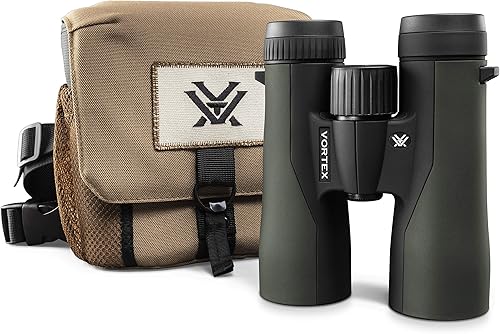
Vortex Crossfire HD 10x42
A 10x42 for birders who mostly watch from a deck, a yard, or one spot on a trail and want birds to look larger. Vortex lists a 6.0 ft close focus, 325 feet of view at 1,000 yards, 15.0 mm of eye relief, and 23.0 oz, and the Amazon listing describes fully multi-coated lenses, twist-up eyecups, a right-eye diopter, nitrogen purging with O-ring seals, and a tripod-adaptable body. One owner who bought it for bird watching says the view stayed wide enough to follow a bird hopping between branches, though the image jitters when held in one hand; another says it focuses to about 8 feet in use, not the advertised 6. Look elsewhere if you wear glasses or follow birds along trails: its 325 ft field is under the 341 ft that Audubon's buying guide asks for, and 15.0 mm sits at the bottom of the 15 to 20 mm range that guide gives for birding binoculars.
Pros
- 6.0 ft close focus, per Vortex
- Tripod adaptable with twist-up eyecups, per the listing
- One owner reports a view wide enough to follow birds
Cons
- 325 ft field, under Audubon's 341 ft line
- 15.0 mm of eye relief, per Vortex
Vortex Triumph HD 10x42
A 10x42 for birders who watch from a distance, such as across a pond or along a field edge, and rarely look at birds close to the house. Vortex lists 17.0 mm of eye relief, 334 feet of view at 1,000 yards, and 22.9 oz, but also a 15.3 ft close focus, so birds nearer than that will not come into focus. According to the Amazon listing, it has a nitrogen-purged, rubber-armored polycarbonate body with adjustable eyecups and a diopter, but the listing's specs are unreliable: one bullet says 1x magnification and the weight is given as 0.45 kg. One owner who watches birds and small animals in a backyard calls the image bright and sharp; another says the magnification can be a little much at close range. Look elsewhere if you watch a feeder within about 15 feet.
Pros
- 17.0 mm of eye relief, per Vortex
- One owner reports a bright, sharp backyard view
- Tripod adaptable, per Vortex
Cons
- 15.3 ft close focus, per Vortex
- Listing gives 1x magnification and a wrong weight
Nikon PROSTAFF P3 8x42
A full-size 8x42 for eyeglass wearers and anyone who wants one light pair for the feeder, the yard, and the trail. According to the Amazon listing, it has turn-and-slide eyecups and long eye relief for use with or without glasses, a fiberglass-reinforced polycarbonate body with rubber armor, and O-ring seals with nitrogen purging against fog and water. Nikon's spec page lists 377 feet of view at 1,000 yards, 20.2 mm of eye relief, and 20.3 oz; that eye relief sits just above the top of the 15 to 20 mm range that Audubon magazine's How To Choose Your Binoculars gives for birding binoculars. Look elsewhere if you want ED glass, or if you often watch birds closer than about 10 feet, since Nikon lists a 9.8 ft close focus.
Pros
- 20.2 mm of eye relief, per Nikon
- 377 ft field of view at 1,000 yards, per Nikon
- 20.3 oz, per Nikon
Cons
- No ED glass listed by Nikon or the listing
- 9.8 ft close focus, per Nikon
Nikon MONARCH M5 8x42
An 8x42 for birders who want Nikon's ED glass in a 42 mm body. According to the Amazon listing, it pairs extra-low dispersion glass with dielectric multilayer prism coatings to cut color fringing, and Nikon's spec page confirms ED glass, phase coating, and dielectric coating. Nikon lists a close focus of 8.2 ft, 19.5 mm of eye relief, and a weight of 22.2 oz. Look elsewhere if a wide view matters most: at 335 feet at 1,000 yards, per Nikon, its field is just under the 341 ft that Audubon's buying guide asks for.
Pros
- ED glass with phase and dielectric coatings, per Nikon
- Focuses to 8.2 ft, per Nikon
- 19.5 mm of eye relief, per Nikon
Cons
- 335 ft field, under Audubon's 341 ft line
- 22.2 oz, per Nikon
Nikon PROSTAFF P3 10x42
A 10x42 for birders who mostly watch from one spot and want birds to look larger. Per Nikon, it shows 367 feet of view at 1,000 yards, above the 341 ft minimum in Audubon magazine's How To Choose Your Binoculars, focuses to 9.8 ft, gives 15.7 mm of eye relief, and weighs 20.6 oz. According to the Amazon listing, it has a rubber-armored, fiberglass-reinforced polycarbonate body, O-ring seals with nitrogen purging, and turn-and-slide eyecups. Look elsewhere if you wear glasses and want more than 15.7 mm of eye relief, or if you have trouble holding binoculars steady.
Pros
- 20.6 oz, per Nikon
- 367 ft at 1,000 yards, above Audubon's 341 ft line
- O-ring sealed and nitrogen purged, per the listing
Cons
- 15.7 mm of eye relief, near the low end of Audubon's 15 to 20 mm range
- 9.8 ft close focus, per Nikon
ZEISS Terra ED 8x42
An 8x42 with ED glass for backyard birders who watch feeders and shrubs at short range. Zeiss lists a 5.3 ft close focus along with 375 feet of view at 1,000 yards and 18 mm of exit pupil distance, which the listing labels eye relief, and the Amazon listing describes ED glass with a hydrophobic multi-coating and a waterproof, fiberglass-reinforced body. Of the 8x42s here that list ED glass, it focuses closest. Owners describe a sharp view and a quick focus wheel, but two describe it as heavy, and one says the case will not zip shut with the strap attached. Look elsewhere if weight matters: Zeiss lists 25.6 oz, and the listing's 3.2 lb figure is about twice that.
Pros
- 5.3 ft close focus, per Zeiss
- 375 ft field of view at 1,000 yards, per Zeiss
- Owners describe fast focusing
Cons
- Two owners describe it as heavy
- Listing weight does not match the Zeiss figure
ZEISS Conquest HDX 10x42
A 10x42 for birders who want a fast focus and a long list of adjustments. According to the Amazon listing, it has ED glass, aspheric lenses, a magnesium housing, a focus wheel that needs only 1.3 rotations, a locking diopter, removable eyecups, and flip-down lens covers. Zeiss lists 90 percent light transmission, 345 feet of view at 1,000 yards, a 6.6 ft close focus, and 25.2 oz, and gives 16.5 mm of eye relief where the listing says 18 mm. Look elsewhere if you wear glasses and want the most eye relief in a 10x42: the Maven B1.2 offers more, per Maven.
Pros
- Focus wheel needs 1.3 rotations, per the listing
- 6.6 ft close focus, per Zeiss
- Locking diopter and removable eyecups, per the listing
Cons
- Leads the 10x42s in this guide on none of the specs in our table
- Listing and Zeiss give different eye relief figures
Maven B.3 8x30
A smaller 8x30 for walkers, travelers, and anyone who leaves full-size binoculars at home because of the weight. Maven lists 16.6 oz and a size of 4.7 in, the lightest and shortest pair in this guide, along with 430 feet of view at 1,000 yards, the widest in this guide, and an 8.2 ft close focus. Maven's spec table lists ED glass, dielectric and phase-correction coatings, and a polymer frame, while the Amazon listing gives the enclosure as magnesium. Look elsewhere if you often bird at dawn, at dusk, or under heavy forest cover, where its 30 mm lenses gather less light than the 42 mm models here.
Pros
- Lightest and smallest here: 16.6 oz and 4.7 in, per Maven
- Widest view here: 430 ft at 1,000 yards, per Maven
- ED glass and dielectric prism coating, per Maven
Cons
- 15.1 mm of eye relief, among the shortest here
- Listing and Maven disagree on frame material
Maven B1.2 10x42
A 10x42 for eyeglass wearers and backyard birders who want 10x without giving up close focus. Maven lists 17.8 mm of eye relief, the most of the 10x42s here, and a 4.9 ft close focus, the shortest in this guide, along with 347 feet of view at 1,000 yards, ED glass, dielectric prism coating, and a magnesium frame. The Amazon listing's spec table gives Maven's 8x42 figures (8x and 420 feet at 1,000 yards) for this 10x model, so go by Maven's numbers. One owner says the eye relief works well with glasses; another, who replaced an older pair of Nikon binoculars, says these weigh a little more and that an eyecup would not stay in place. Look elsewhere if you want a lighter 10x42.
Pros
- Shortest close focus here at 4.9 ft, per Maven
- Most eye relief of the 10x42s: 17.8 mm, per Maven
- One owner reports good eye relief with glasses
Cons
- Heaviest 10x42 here at 26.8 oz, per Maven
- Listing spec table shows 8x42 figures
How We Chose
We searched Amazon US for birding and bird watching binoculars, including 8×42 and 10×42 models, and considered pairs from every brand on our reviewed list for this category: Vortex, Nikon, Bushnell, Celestron, Zeiss, Leupold, Maven, Steiner, and Athlon Optics. Each pair had to be sold new, average at least 4.0 out of 5 from at least 30 owner ratings, and be described for bird watching or birding somewhere in its own Amazon listing: the title, the feature bullets, the description, or a spec field such as Specific Uses. For the three Vortex pairs, that bird watching use comes from the Specific Uses field of the Amazon listings; Vortex’s own pages list them for hunting and wildlife observation. That last rule removed many popular hunting, marine, and general-purpose pairs from these brands. Where one model was sold under two listings, such as a plain and a camouflage version, we kept one. We took no more than three models from one brand, which is why there are three Vortex and three Nikon pairs, and more than ten pairs met every rule, so we left out two pairs, including a 12x model that suits backyard birding poorly.
For the top spot we prefer a pair with at least 1,000 owner ratings. Among the pairs that clear that bar, we went back to what birding binoculars need, as described in the two Audubon guides cited below: 7x or 8x power and a field of view of at least 341 ft at 1,000 yards. The Vortex Diamondback HD 8×42 meets both, with 393 ft per Vortex, so it takes Best Overall; the Vortex Crossfire HD 10×42, a 10x with a 325 ft field, follows it. The other eight follow our research order for this guide. The FeederBirdLab Score on each card does not set the order of this list or the Best Overall; it reflects owner ratings and our checks of each listing against the maker, as explained in how we calculate the score.
We then opened each maker’s spec page and matched it to the listing by model number, such as Vortex’s CF-4312, DB-214, and TRI-1042, or by model name and size. Vortex, Nikon, Zeiss, and Maven all still list these exact models on their own sites. Five listings clearly conflict with the maker on the same model: the weights of the Diamondback HD, the Triumph HD, and the Terra ED; the frame material of the Maven B.3; and the magnification figures in the Maven B1.2’s spec table. For each of those we lowered the FeederBirdLab Score by 0.2. The Triumph HD listing also gives 1x magnification in one bullet; we counted its errors once. Smaller gaps, such as the Conquest HDX’s eye relief, are shown in the table but did not change a score. Our full method is on the How We Review page.
How to Choose the Best Binoculars for Bird Watching
The two numbers on every binocular, such as 8×42, are the magnification and the diameter of the front lens in millimeters, as Audubon magazine’s buying guide explains. Those two numbers are only the start; four other specs separate these ten pairs more clearly: field of view, close focus, eye relief, and weight.
8x or 10x
The Audubon Guide to Binoculars says most birders prefer 7- or 8-power binoculars because they are bright and have a wide field of view, which makes it easier to find birds and follow them in flight. This list includes both powers, and choosing between an 8×42 and a 10×42 depends mostly on where you bird and how steadily you can hold the view.
Field of view: Audubon’s 341-foot line
A wide field of view makes it easier to find a bird and keep it in view as it moves. Audubon magazine’s buying guide says birding binoculars should have an angle of view of at least 6.5 degrees, which works out to 341 feet at 1,000 yards. Seven of the ten meet that line on the maker’s figures: the Maven B.3 (430 ft), the Vortex Diamondback HD (393 ft), both Nikon PROSTAFF P3s (377 ft and 367 ft), the Zeiss Terra ED (375 ft), the Maven B1.2 (347 ft), and the Zeiss Conquest HDX (345 ft). Three fall short: the Nikon MONARCH M5 (335 ft), the Vortex Triumph HD (334 ft), and the Vortex Crossfire HD (325 ft). One Crossfire owner who bought it for bird watching says its view stayed wide enough to keep a bird in frame as it hopped from branch to branch. On the seven pairs above the line, that extra width helps you stay with a warbler working through leaves.
Close focus for feeder and window birds
Close focus is the nearest distance at which the binoculars show a sharp image. It matters more in a backyard than on a lake: if your feeder hangs 10 feet from the window, a pair that cannot focus closer than 15.3 ft will not show it sharply. The range across these ten is wide, per the makers: 4.9 ft for the Maven B1.2; 5.0 ft for the Vortex Diamondback HD; 5.3 ft for the Zeiss Terra ED; 6.0 ft for the Vortex Crossfire HD; 6.6 ft for the Zeiss Conquest HDX; 8.2 ft for the Nikon MONARCH M5 and the Maven B.3; 9.8 ft for both Nikon PROSTAFF P3s; and 15.3 ft for the Vortex Triumph HD. Treat these as a guide rather than a promise: one Crossfire owner says the pair focuses to about 8 feet in use, not the advertised 6. Another owner says the Terra ED’s close focus has been great for looking at details on birds at a feeder just 15 feet away.
Eye relief if you wear glasses
Eye relief is how far behind the eyepiece your eye can sit and still take in the whole image, and eyeglass wearers need more of it because their lenses hold the eye farther back. On the makers’ figures, the Nikon PROSTAFF P3 8×42 leads at 20.2 mm, followed by the Nikon MONARCH M5 at 19.5 mm, the Zeiss Terra ED at 18 mm, and the Vortex Diamondback HD at 17.0 mm. Among the 10x42s, the Maven B1.2 leads at 17.8 mm, ahead of the Vortex Triumph HD at 17.0 mm; the Zeiss Conquest HDX lists 16.5 mm and the Nikon PROSTAFF P3 10×42 15.7 mm. The two shortest are the Vortex Crossfire HD at 15.0 mm and the Maven B.3 at 15.1 mm. One Crossfire owner says the eye has to sit at an exact distance from the eyepiece to see the full field. Most of the ten have eyecups that twist or slide down for use with glasses, per their listings or makers.
Size and weight
Audubon magazine’s buying guide says objective lenses larger than 42 mm make binoculars too heavy for most people to carry all day, while midsized models give up a little detail in poor light in exchange for less size and weight. Among these ten, the Maven B.3 8×30 is the lightest at 16.6 oz, per Maven, while the 42 mm models run from 20.3 oz (Nikon PROSTAFF P3 8×42) to 26.8 oz (Maven B1.2). The three Vortex pairs sit in the middle at 21.8 to 23.0 oz. If you want a compact pair, note that the B.3 is the only 30 mm pair in this guide and still clears Audubon’s field-of-view line.
Weather sealing and glass
All ten are described as waterproof and as filled or purged with gas by their makers: nitrogen for nine, argon for the Diamondback HD. Nikon rates its three as waterproof down to 3.3 ft, and Maven gives its two an IPX7 rating (1 m for 30 minutes). Five list ED glass, the Conquest HDX only in its Amazon listing, while the three Vortex pairs and the two PROSTAFF P3s do not; Vortex describes an HD optical system of select glass elements that cuts chromatic aberration, without naming the glass type.
Who Should Look Elsewhere
If you would rather carry a single small tube and can live with using one eye, consider a monocular instead of a binocular. For ducks and shorebirds far across the water, none of these pairs goes past 10x; a spotting scope on a tripod is the next step up.
Skip the Vortex Triumph HD if you watch feeders near the house, since Vortex lists a 15.3 ft close focus. Skip the Vortex Crossfire HD if you wear glasses and want the full field without fuss, or if you bird mostly in thick woods, where its field is the narrowest of the ten. Skip the Maven B.3 if you bird mostly at dawn and dusk under heavy cover, where Audubon says midsized lenses give up some detail. And if weight decides it, the Zeiss Terra ED and the Maven B1.2 are the heaviest 42 mm pairs here at 25.6 oz and 26.8 oz, per their makers.
Bird Watching Binoculars FAQ
Which of these binoculars suit most birders?
Of the best birding binoculars in this guide, the Vortex Diamondback HD 8×42, the Nikon PROSTAFF P3 8×42, and the Zeiss Terra ED 8×42 fit the 7x or 8x, full-size profile that Audubon magazine’s buying guide describes, and the Maven B.3 8×30 fits it in a midsized body. All four clear the guide’s 341 ft field-of-view line. Of the four, the Diamondback HD has the widest view and the closest focus, per Vortex. We suggest the 10x pairs mainly for watching from one spot or for birds at a distance.
Is the Vortex Crossfire HD 10×42 a good choice for birding?
It can be, if you mostly watch from one spot and want birds to look larger. Vortex lists a 6.0 ft close focus at 23.0 oz. The trade-offs are a 325 ft field, the narrowest of the ten and under Audubon’s 341 ft line, and 15.0 mm of eye relief, the shortest of the ten, per Vortex. One owner who bought it for bird watching says the view stayed wide enough to follow birds, but that the 10x jitters when held in one hand and that they would likely have been just as happy with the 8x. If you plan to walk trails and follow birds in flight, the Diamondback HD 8×42 is the better match for Audubon’s advice.
Which binoculars work best for watching a backyard feeder?
Look first at close focus, since feeders and shrubs are often closer than birds on a trail. The Maven B1.2 (4.9 ft), Vortex Diamondback HD (5.0 ft), and Zeiss Terra ED (5.3 ft) focus closest, per their makers; the Vortex Triumph HD, at 15.3 ft, is the weakest choice for this job.
Do I need ED glass for bird watching?
Not necessarily. The Amazon listing for the Nikon MONARCH M5 says its ED (extra-low dispersion) glass and prism coatings minimize chromatic aberration and color fringing, and five of the ten list ED glass, the Conquest HDX only in its Amazon listing. Audubon magazine’s buying guide does not include ED glass in its list of what birding binoculars need: brightness, sharpness, fast focus, a wide field of view, accurate color, fog resistance, and room for eyeglasses. None of the three Vortex pairs, including our Best Overall, names ED glass. If you want it in an 8×42, the Zeiss Terra ED and the Nikon MONARCH M5 are the two options in this guide.
Which of these binoculars are best if I wear glasses?
On paper, the Nikon PROSTAFF P3 8×42 is the best fit, with 20.2 mm of eye relief per Nikon, the most in this guide; among 10x42s the Maven B1.2 leads at 17.8 mm per Maven. Audubon magazine’s buying guide suggests the real check: whether you can see the entire field of view with your eyeglasses on.
Final Thoughts
Pick the magnification that fits where your birds are, then check close focus and eye relief. Our picks by need:
- Best Overall: Vortex Diamondback HD 8×42. 393 ft of view and a 5.0 ft close focus, per Vortex.
- Best for Eyeglass Wearers: Nikon PROSTAFF P3 8×42. The most eye relief in this guide at 20.2 mm, per Nikon.
- Best Lightweight 10×42: Nikon PROSTAFF P3 10×42. The lightest of the five 10x42s at 20.6 oz, per Nikon.
- Best 8×42 with ED Glass: ZEISS Terra ED 8×42. ED glass with a 5.3 ft close focus, per Zeiss.
- Best Compact: Maven B.3 8×30. The lightest and shortest pair in this guide, per Maven.
- Best Close-Focusing 10×42: Maven B1.2 10×42. A 4.9 ft close focus, the shortest of the ten, per Maven.
To start birding, one 8x pair from this list and a bird identification book or app are enough. For more optics and field gear, browse our Binoculars & Birding Gear section.
About the author

Vicki Armstrong is a Colorado-based nature writer and recreational photographer with eight years of birdwatching experience on local trails and across the western United States. Vicki researches smart bird feeders, binoculars, and birding accessories, focusing on features that help people observe and document birds. Vicki also writes regional identification guides that explain field marks, habitat, seasonal occurrence, and commonly confused species.