
Best Beginner Bird Watching Binoculars: 10 Pairs for New Birders
Ten binoculars for new birders compared on field of view, eye relief, close focus, weight, and fit, with our pick for a first pair.
 Updated November 2, 2026
The best beginner bird watching binoculars are an 8x pair with a wide field of view, eyecups that work with or without glasses, and a body sealed against rain, because a new birder’s first problem is finding the bird, not making it bigger. Our Best Overall is the Celestron Nature DX 8×42. Per Celestron, it shows 388 feet at 1,000 yards, focuses down to 6.5 ft, and gives 17.5 mm of eye relief with twist-up eyecups that have multiple stops, at 22.2 oz. Celestron describes the 8×42 as a favorite among beginning and intermediate birders because birds are easier to locate and follow in its wide view. We compare ten pairs and show which numbers make a first pair easy to live with.
We compared the ten on field of view, close focus, eye relief and eyecups, weight, how close the barrels fold for narrow-set eyes, and weather sealing. Three published sources shape what a beginner should look for. Audubon magazine’s How To Choose Your Binoculars says many beginners assume more magnification is better, and calls that a mistake because brightness and field of view matter far more. The Mass Audubon guide to fitting and focusing binoculars says that if you are inexperienced, the wider view of an 8-power pair helps more than a 10 when you are trying to locate a bird. A binocular basics sheet hosted by the Missouri Department of Conservation and credited to the Iowa Department of Natural Resources calls many 7×35 and 8×42 binoculars good for bird watching, and says they should be easy and comfortable to use.
We earn a commission from qualifying purchases made through links on this page. Commissions never affect our rankings or FeederBirdLab Scores.
Our Top Binocular Picks for Beginner Birders
- Best Overall: Celestron Nature DX 8×42. An 8x with 388 ft of view, well past Audubon’s 341 ft minimum, plus 17.5 mm of eye relief and twist-up eyecups with multiple stops, per Celestron.
- Best Wide View: Celestron TrailSeeker ED 8×42. The widest field of the nine pairs with a maker figure, 426 ft at 1,000 yards, with ED glass and a 6.5 ft close focus, per Celestron.
- Best for Eyeglass Wearers: Nikon PROSTAFF P3 8×42. The most eye relief of the ten (20.2 mm) and the lowest weight of the 42 mm pairs (20.3 oz), per Nikon.
- Best Lightweight 10×42: Nikon PROSTAFF P3 10×42. At 20.6 oz the lightest of the four 10x42s, and the only one that clears Audubon’s 341 ft line (367 ft), per Nikon.
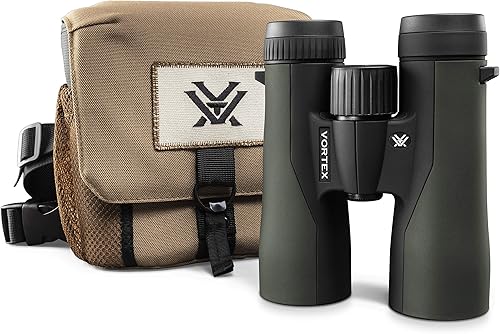
- Best Close-Focusing 10x: Vortex Crossfire HD 10×42. A 6.0 ft close focus, the shortest of the five 10x pairs, and an unlimited, unconditional lifetime warranty, per the maker.
Five pairs carry no title. The Nikon MONARCH M5 8×42 adds ED glass and 19.5 mm of eye relief, per Nikon, but its 335 ft field falls just under Audubon’s line. The Vortex Triumph HD 10×42 cannot focus closer than 15.3 ft, per Vortex, so a feeder nearer than that will not come into focus. The Athlon Optics Forerunner 10×42 has a 14.7 ft close focus on Athlon’s spec sheet, and Athlon lists it under Limited Distribution. The Celestron Outland X 10×50 is the heaviest pair here at 27 oz with the narrowest maker-listed field (294 ft), per Celestron. The Bushnell PowerView 2 8×21 is the smallest, but its specs come only from the listing, and 10 mm of eye relief is short for glasses.
Beginner Birding Binoculars Compared
Figures come from each maker’s page or spec sheet, linked in the first column, unless a cell says listing. Field of view is the width of the scene at 1,000 yards. Minimum barrel spacing (interpupillary distance) is how close the eyepieces fold together; a lower number suits narrow-set eyes. The last column shows where the Amazon listing gives a different figure for the same model.
| Binocular | Field of view at 1,000 yd | Close focus | Eye relief | Eyecups | Weight | Min. barrel spacing | Where the listing differs |
|---|---|---|---|---|---|---|---|
| Celestron Nature DX 8×42 (Celestron) | 388 ft | 6.5 ft | 17.5 mm | Twist-up, multiple stops | 22.2 oz | 56 mm | Weight given as 1.8 lb |
| Celestron TrailSeeker ED 8×42 (Celestron) | 426 ft | 6.5 ft | 17.2 mm | Twist-up, click stops | 23.5 oz | 56 mm | None on these specs |
| Nikon PROSTAFF P3 8×42 (Nikon) | 377 ft | 9.8 ft | 20.2 mm | Turn-and-slide (listing) | 20.3 oz | Not listed | None on these specs |
| Nikon PROSTAFF P3 10×42 (Nikon) | 367 ft | 9.8 ft | 15.7 mm | Turn-and-slide (listing) | 20.6 oz | Not listed | None on these specs |
| Nikon MONARCH M5 8×42 (Nikon) | 335 ft | 8.2 ft | 19.5 mm | Adjustable (listing gives two types) | 22.2 oz | Not listed | None on these specs |
| Vortex Crossfire HD 10×42 (Vortex) | 325 ft | 6.0 ft | 15.0 mm | Twist up and down | 23.0 oz | 58 mm | None on these specs |
| Celestron Outland X 10×50 (Celestron) | 294 ft | 8.2 ft | 17.4 mm | Twist-up (listing) | 27 oz | 56 mm | Field given as 289 ft |
| Athlon Optics Forerunner 10×42 (Athlon) | 336 ft | 14.7 ft | 16.1 mm | Twist-up | 24 oz | 53 mm | Field given as 6.8 degrees (Athlon: 6.4) |
| Vortex Triumph HD 10×42 (Vortex) | 334 ft | 15.3 ft | 17.0 mm | Twist up and down | 22.9 oz | 55 mm | Weight given as 0.45 kg; field given as 0.67 degrees |
| Bushnell PowerView 2 8×21 (no maker page found) | Not confirmed | Not listed | 10 mm (listing) | Not listed | About 9.6 oz (listing) | Not listed | Field given as 3.14 degrees, which we could not confirm |
Our ranking reflects our overall assessment of specifications, maker information, and owner reviews. The FeederBirdLab Score is a separate measure based on Amazon customer ratings with a limited editorial adjustment, and it does not set the order.
| Product | FeederBirdLab Score About FeederBirdLab ScoreThe FeederBirdLab Score is our own rating out of 10. It starts from the average Amazon customer rating, may be adjusted by the editor by up to 0.5 points, and is never influenced by brands, retailers, or affiliate commissions. Learn more › | |
|---|---|---|
 Celestron Nature DX 8x42 |
8.6/10 | Buy |
 Celestron TrailSeeker ED 8x42 |
8.8/10 | Buy |
 Nikon PROSTAFF P3 8x42 |
8.9/10 | Buy |
 Nikon PROSTAFF P3 10x42 |
8.8/10 | Buy |
 Nikon MONARCH M5 8x42 |
8.9/10 | Buy |
 Vortex Crossfire HD 10x42 |
9.1/10 | Buy |
 Celestron Outland X 10x50 |
8.8/10 | Buy |
 Athlon Optics Forerunner 10x42 |
8.4/10 | Buy |
 Vortex Triumph HD 10x42 |
8.7/10 | Buy |
 Bushnell PowerView 2 8x21 |
8.0/10 | Buy |
Celestron Nature DX 8x42
An 8x42 for a first serious pair, built around a view wide enough to find birds quickly. Per Celestron, it shows 388 feet at 1,000 yards, focuses to 6.5 ft, and has 17.5 mm of eye relief with twist-up eyecups with multiple stops, at 22.2 oz in a waterproof, nitrogen-filled body; Celestron calls the 8x42 a favorite among beginning and intermediate birders. The Amazon listing gives the weight as 1.8 pounds, well above Celestron's figure. One owner set up the same model for family members from a 9-year-old to parents in their 80s, and another who bought it for a birding trip found it easy to use with glasses but darker than costlier pairs in a shady thicket. Look elsewhere if you often bird at dawn under heavy cover or want ED glass.
Pros
- 388 ft field of view at 1,000 yards, per Celestron
- 17.5 mm of eye relief with multiple-stop twist-up eyecups
- 6.5 ft close focus, per Celestron
Cons
- One owner had both eyecups come loose (replaced under warranty)
- Listing weight of 1.8 lb conflicts with Celestron's 22.2 oz
Celestron TrailSeeker ED 8x42
A step-up 8x42 for newer birders who want ED glass and a very wide view in a full-size pair. Per Celestron, it shows 426 feet at 1,000 yards, focuses to 6.5 ft, and has 17.2 mm of eye relief with click-stop twist-up eyecups, at 23.5 oz in a waterproof, nitrogen-filled magnesium alloy body with phase- and dielectric-coated prisms. One owner calls it their first nice pair and says they can scan a whole tree line in one pass; another calls it easy to use, while a third disliked it at first until they had it adjusted for their own eyes. Look elsewhere if the lightest possible pair matters more than field width.
Pros
- 426 ft field of view at 1,000 yards, per Celestron
- ED glass with phase and dielectric prism coatings, per Celestron
- 6.5 ft close focus and 17.2 mm of eye relief
Cons
- 23.5 oz, per Celestron
- One owner found the neck strap tiring after hours of carry
Nikon PROSTAFF P3 8x42
A full-size 8x42 for eyeglass wearers and anyone who wants one light pair for the feeder, the yard, and the trail. According to the Amazon listing, it has turn-and-slide eyecups and long eye relief for use with or without glasses, a fiberglass-reinforced polycarbonate body with rubber armor, and O-ring seals with nitrogen purging against fog and water. Nikon's spec page lists 377 feet of view at 1,000 yards, 20.2 mm of eye relief, and 20.3 oz; that eye relief sits just above the top of the 15 to 20 mm range that Audubon magazine's How To Choose Your Binoculars gives for birding binoculars. Look elsewhere if you want ED glass, or if you often watch birds closer than about 10 feet, since Nikon lists a 9.8 ft close focus.
Pros
- 20.2 mm of eye relief, per Nikon
- 377 ft field of view at 1,000 yards, per Nikon
- 20.3 oz, per Nikon
Cons
- No ED glass listed by Nikon or the listing
- 9.8 ft close focus, per Nikon
Nikon PROSTAFF P3 10x42
A 10x42 for birders who mostly watch from one spot and want birds to look larger. Per Nikon, it shows 367 feet of view at 1,000 yards, above the 341 ft minimum in Audubon magazine's How To Choose Your Binoculars, focuses to 9.8 ft, gives 15.7 mm of eye relief, and weighs 20.6 oz. According to the Amazon listing, it has a rubber-armored, fiberglass-reinforced polycarbonate body, O-ring seals with nitrogen purging, and turn-and-slide eyecups. Look elsewhere if you wear glasses and want more than 15.7 mm of eye relief, or if you have trouble holding binoculars steady.
Pros
- 20.6 oz, per Nikon
- 367 ft at 1,000 yards, above Audubon's 341 ft line
- O-ring sealed and nitrogen purged, per the listing
Cons
- 15.7 mm of eye relief, near the low end of Audubon's 15 to 20 mm range
- 9.8 ft close focus, per Nikon
Nikon MONARCH M5 8x42
An 8x42 for birders who want Nikon's ED glass in a 42 mm body. According to the Amazon listing, it pairs extra-low dispersion glass with dielectric multilayer prism coatings to cut color fringing, and Nikon's spec page confirms ED glass, phase coating, and dielectric coating. Nikon lists a close focus of 8.2 ft, 19.5 mm of eye relief, and a weight of 22.2 oz. Look elsewhere if a wide view matters most: at 335 feet at 1,000 yards, per Nikon, its field is just under the 341 ft that Audubon's buying guide asks for.
Pros
- ED glass with phase and dielectric coatings, per Nikon
- Focuses to 8.2 ft, per Nikon
- 19.5 mm of eye relief, per Nikon
Cons
- 335 ft field, under Audubon's 341 ft line
- 22.2 oz, per Nikon
Vortex Crossfire HD 10x42
A 10x42 for birders who mostly watch from a deck, a yard, or one spot on a trail and want birds to look larger. Vortex lists a 6.0 ft close focus, 325 feet of view at 1,000 yards, 15.0 mm of eye relief, and 23.0 oz, and the Amazon listing describes fully multi-coated lenses, twist-up eyecups, a right-eye diopter, nitrogen purging with O-ring seals, and a tripod-adaptable body. One owner who bought it for bird watching says the view stayed wide enough to follow a bird hopping between branches, though the image jitters when held in one hand; another says it focuses to about 8 feet in use, not the advertised 6. Look elsewhere if you wear glasses or follow birds along trails: its 325 ft field is under the 341 ft that Audubon's buying guide asks for, and 15.0 mm sits at the bottom of the 15 to 20 mm range that guide gives for birding binoculars.
Pros
- 6.0 ft close focus, per Vortex
- Tripod adaptable with twist-up eyecups, per the listing
- One owner reports a view wide enough to follow birds
Cons
- 325 ft field, under Audubon's 341 ft line
- 15.0 mm of eye relief, per Vortex
Celestron Outland X 10x50
A 10x50 for watching from one spot, such as a window over the feeders, when you want birds to look large. Per Celestron, it gives 294 feet of view at 1,000 yards, focuses to 8.2 ft, and has 17.4 mm of eye relief, at 27 oz in a waterproof, nitrogen-filled body; the Amazon listing describes porro prisms, twist-up eyecups, and a large textured focus wheel. One owner's wife uses it at their backyard feeders, while another found the field of view smaller than expected and the sweet spot hard to find, and a third calls it much too heavy. Look elsewhere if you plan to walk with it all morning: its 50 mm lenses are past the 42 mm that Audubon's buying guide calls the practical limit for carrying all day.
Pros
- 17.4 mm of eye relief, per Celestron
- Waterproof and nitrogen filled, per Celestron
- Large textured focus wheel, per the listing
Cons
- 27 oz, per Celestron
- 294 ft field, under Audubon's 341 ft line
Athlon Optics Forerunner 10x42
A 10x42 for watching birds at a distance from one spot. Per Athlon's spec sheet, it gives 336 feet of view at 1,000 yards, 16.1 mm of eye relief with twist-up eyecups, a 14.7 ft close focus, and 24 oz, and its barrels fold to 53 mm, a help if your eyes are set close together. Athlon lists the model under Limited Distribution on its site, so availability may change. Look elsewhere if you watch feeders near the house: at 14.7 ft, the close focus is long for backyard birds.
Pros
- 336 ft field of view, per Athlon
- Barrels fold to 53 mm for close-set eyes
- Waterproof and nitrogen purged, per Athlon
Cons
- 14.7 ft close focus, per Athlon
- Listed by Athlon under Limited Distribution
Vortex Triumph HD 10x42
A 10x42 for birders who watch from a distance, such as across a pond or along a field edge, and rarely look at birds close to the house. Vortex lists 17.0 mm of eye relief, 334 feet of view at 1,000 yards, and 22.9 oz, but also a 15.3 ft close focus, so birds nearer than that will not come into focus. According to the Amazon listing, it has a nitrogen-purged, rubber-armored polycarbonate body with adjustable eyecups and a diopter, but the listing's specs are unreliable: one bullet says 1x magnification and the weight is given as 0.45 kg. One owner who watches birds and small animals in a backyard calls the image bright and sharp; another says the magnification can be a little much at close range. Look elsewhere if you watch a feeder within about 15 feet.
Pros
- 17.0 mm of eye relief, per Vortex
- One owner reports a bright, sharp backyard view
- Tripod adaptable, per Vortex
Cons
- 15.3 ft close focus, per Vortex
- Listing gives 1x magnification and a wrong weight
Bushnell PowerView 2 8x21
A small folding roof prism pair for occasional birders who want something for the glove box or a day bag. According to the Amazon listing, it has an aluminum alloy chassis, weighs 272 g (about 9.6 oz), gives 10 mm of eye relief, and is waterproof. Bushnell's US site did not show this model when we checked, so none of these figures are confirmed by the maker. Look elsewhere if you bird in low light or wear glasses: Audubon's buying guide says objectives smaller than 30 mm are not bright enough to show all the detail you need in poor light, and 10 mm of eye relief is short.
Pros
- About 9.6 oz, per the listing
- Folding design for a pocket or glove box
- Aluminum alloy chassis, per the listing
Cons
- 21 mm lenses, under Audubon's 30 mm guideline
- Specs not confirmed on a maker page
How We Chose
We searched Amazon US for beginner and bird watching binoculars and for pairs from the binocular brands on our reviewed list. Each pair had to be sold new, average at least 4.0 out of 5 from at least 30 owner ratings, and be described for bird watching or birding somewhere in its own Amazon listing: the title, the feature bullets, the description, or a spec field. For the two Vortex pairs, that bird watching use comes only from the Specific Uses field of the Amazon listings; Vortex’s own pages list them for hunting and wildlife observation. We took no more than three pairs from one brand, which is why there are three each from Celestron and Nikon.
For the top spot we prefer a pair from a brand on our list with 1,000 or more owner ratings and an average of at least 4.2, then pick the one that fits a beginner best on published criteria: 7x or 8x power and a field of view of at least 341 ft, the line in Audubon magazine’s buying guide. The Celestron Nature DX 8×42 met that bar, is an 8x, and clears 341 ft with 388 ft per Celestron, with 17.5 mm of eye relief and twist-up eyecups with multiple stops, so it takes Best Overall. After the top pick, the pairs are ordered by how many of four beginner marks drawn from Audubon’s buying guide they meet on the maker’s figures: 7x or 8x power, at least 341 ft of field, at least 15 mm of eye relief, and a close focus under 10 ft. Pairs that meet the same number are ordered by field of view. That puts the TrailSeeker ED and the PROSTAFF P3 8×42 (all four marks) next, then the PROSTAFF P3 10×42 and the MONARCH M5 (three), the Vortex Crossfire HD and the Outland X (two), and the Athlon Forerunner and the Vortex Triumph HD (one). The Bushnell comes last because most of its figures cannot be checked. The FeederBirdLab Score on each card is a separate measure and does not set the order or the Best Overall, as explained in how we calculate the score.
We then opened each maker’s page or spec sheet and matched it to the listing by model number, such as Celestron’s 71332, Vortex’s CF-4312 and TRI-1042, Nikon’s 16776, and Athlon’s 117001. Two listings clearly conflict with the maker on the same model: the Nature DX listing gives 1.8 lb against Celestron’s 22.2 oz, and the Triumph HD listing gives 0.45 kg and a field of 0.67 degrees against Vortex’s 22.9 oz and 6.4 degrees. We lowered the FeederBirdLab Score of each by 0.2. Smaller gaps, such as the Outland X and Athlon field of view figures, are shown in the table but did not change a score. Bushnell’s US site did not show the PowerView 2 8×21 when we checked, so its figures are the listing’s. Our full method is on the How We Review page.
How to Choose the Best Beginner Bird Watching Binoculars
A first pair has a different job from an upgrade. If you already bird often and want to compare high-end glass, this beginner list is too narrow. For a beginner, the pair has to make finding a bird quick and has to fit your face and hands from the first day, so these are the specs to read first.
Field of view before magnification
Audubon magazine’s guide explains the reason with a paper towel tube: try to find a robin through a whole tube, then through a short piece of it, and the wider view wins. It sets the minimum for birding at 6.5 degrees, or 341 feet at 1,000 yards. Four pairs here clear it on the maker’s figures: the Celestron TrailSeeker ED (426 ft), the Celestron Nature DX (388 ft), the Nikon PROSTAFF P3 8×42 (377 ft), and the Nikon PROSTAFF P3 10×42 (367 ft). Five fall short: the Athlon Forerunner (336 ft), Nikon MONARCH M5 (335 ft), Vortex Triumph HD (334 ft), Vortex Crossfire HD (325 ft), and Celestron Outland X (294 ft). The Bushnell has no maker figure. Nikon’s own comparison of its two PROSTAFF P3 powers puts the trade in plain terms: the 8x is easier to hold steady, while subjects appear larger in the 10x. The same Audubon guide lists sizes close to 6×32, 8×32, 7×35, 8×40, 7×42, 8×42, and 8.5×44 as suitable for birding, and says objectives smaller than 30 mm are not bright enough to show all the detail you need in poor light. The five 10x pairs and the 8×21 Bushnell sit outside that list; they are here because their listings sell them for bird watching, and the order above reflects it.
Eye relief and eyecups, with or without glasses
Audubon’s guide says binoculars designed for birders give 15 to 20 mm of eye relief, with eyecups fully retracted when you wear glasses and fully extended when you do not. Nine of the ten fall within that range or just above it on the maker’s or listing figures, from 15.0 mm on the Crossfire to 20.2 mm on the PROSTAFF P3 8×42; the Bushnell’s 10 mm, per the listing, does not. Eyecup design matters for a beginner too. Both Celestron 8x42s use twist-up eyecups with several stops, per Celestron, so you can set a middle position that suits you and find it again. One Nature DX owner says the black blobs some people see just mean the eyepieces are pressed too far into the eye socket, so the eyecups should be extended unless you wear glasses.
Make sure the barrels fit your eyes
Every binocular hinges in the middle so the eyepieces can match the space between your eyes. Audubon’s guide says that if your eyes are closely set, make sure the barrels adjust far enough to show a single image, and the state-agency sheet adds that if the barrels are as close as they go and you still see two images, you may need another pair. This is where the maker spec sheets help: the Athlon folds to 53 mm, the Vortex Triumph to 55 mm, all three Celestrons to 56 mm, and the Vortex Crossfire to 58 mm. Nikon’s pages for its three pairs do not give the figure. If you plan to share the pair with a partner, or with a friend who is also new to birding, the lower that number, the more faces it fits. Once the barrels fit, set the diopter for your eyes one time, as the Mass Audubon guide describes, and use only the center wheel after that.
Close focus for a first feeder view
Most beginners start at the window or the feeder, and close focus decides whether a bird 10 feet away will be sharp. Per the makers, the Vortex Crossfire focuses to 6.0 ft and both Celestron 8x42s to 6.5 ft; the Nikon MONARCH M5 and the Celestron Outland X reach 8.2 ft and the two PROSTAFF P3s 9.8 ft. The Athlon Forerunner (14.7 ft) and the Vortex Triumph HD (15.3 ft) are poor choices if your feeder hangs close to the house. Treat the published figure as a best case: one Crossfire owner says it focuses to about 8 feet in use, not the advertised 6.
Weight for a first long walk
Audubon’s guide says binoculars with objective lenses larger than 42 mm will be too big and heavy for most people to carry all day. The Outland X 10×50 is the one pair here past that size, and at 27 oz it is also the heaviest, per Celestron; one owner calls it much too heavy. The 42 mm pairs run from 20.3 oz (PROSTAFF P3 8×42) to 24 oz (Athlon). The Bushnell 8×21 weighs about 9.6 oz, per the listing, which makes it the easy one to leave in a coat pocket, at the cost of 21 mm lenses and short eye relief. One Nature DX owner who bought it for parents in their 80s compares its weight to two 12 oz cans and says it suited them.
Sealing and warranty for a first pair
First pairs get dropped, rained on, and left in cars. All ten are described as waterproof by the maker or the listing, and the nine with maker pages or spec sheets are nitrogen filled or gas purged. Nikon rates its three as waterproof down to 3.3 ft. Warranty terms differ. According to Vortex’s pages, both of its pairs here carry an unlimited, unconditional lifetime warranty. Celestron’s Nature DX page and the listings for the other two Celestron pairs give a limited lifetime warranty, according to those pages. The Nikon listings describe their coverage as limited lifetime. One Nature DX owner whose eyecup screws backed out over several months says Celestron replaced the pair under warranty. Read the terms before you buy, since “limited” usually means wear and accidents are not covered.
Who Should Look Elsewhere
If you want a pair that slips into a jacket pocket and the Bushnell’s specs are too thin to trust, compact binoculars come with different tradeoffs from the full-size pairs here. If the pair is mainly for a child, note that these ten were picked as adult pairs, not as kids’ binoculars. And if you mostly bird at dawn under heavy cover, one Nature DX owner who borrowed costlier pairs on a trip found the Nature DX view darker in a shady thicket, so that is the case where spending more can pay off.
Among the picks, skip the Vortex Triumph HD and the Athlon Forerunner if you watch a feeder from the house, given their close focus of 15.3 ft and 14.7 ft. Skip the Vortex Crossfire HD if you wear glasses and want the full field without fuss, since its 15.0 mm sits at the bottom of Audubon’s range. Skip the Outland X if you plan to walk with it all morning. Audubon’s guide also warns against asking non-birders such as hunters, boaters, and hikers for advice, since their needs differ; note that Vortex’s own pages describe both of its pairs here in terms of hunting.
Beginner Binoculars FAQ
What comes in the box with a first pair of binoculars?
It varies, so check before you buy. Celestron lists a neck strap, objective lens caps, a rainguard, a carrying case, a lens cloth, and a manual with the Nature DX; the TrailSeeker ED comes with lens and eyepiece caps, a neck strap, a carrying harness, a soft case, a lens cloth, and a manual. Vortex lists a GlassPak harness, a neck strap, tethered objective covers, a rainguard, and a lens cloth with the Crossfire HD. Two TrailSeeker owners prefer the included harness to the neck strap once they are out for hours.
Why do I see two circles or dark shadows through new binoculars?
Usually the barrels or eyecups are not set for you yet. Fold the barrels until you see one circle, as the state-agency sheet describes, and set the eyecups down if you wear glasses, per the Mass Audubon guide, and fully extended if you do not, per Audubon magazine. If the barrels are fully closed and you still see two images, the pair is too wide for your eyes; check the minimum barrel spacing in the table.
Can one pair of binoculars work for the whole family?
Often, if the barrels fold close enough and everyone resets the hinge and diopter. One Nature DX owner set up the same model for parents in their 80s and a family of five, down to a 9-year-old. The state-agency sheet notes the hinge setting stays the same for your eyes on any binocular, so each person can remember their number.
What warranty should a first pair of binoculars have?
Read exactly what the coverage includes and keep your proof of purchase. One Nature DX owner had to send the pair back when the eyecup screws backed out, and says other buyers reported the same. Vortex’s pages describe its coverage as unlimited, unconditional, and lifetime; Celestron and Nikon describe theirs as limited lifetime, and the TrailSeeker ED listing spells out Celestron’s limits, such as covering the optics for the original owner while exterior and accessory coverage is shorter.
Final Thoughts
Choose an 8x with a wide view, fit the barrels and eyecups to your face, and check close focus against where your feeder hangs. Our picks by need:
- Best Overall: Celestron Nature DX 8×42. 388 ft of view, 6.5 ft close focus, and 17.5 mm of eye relief, per Celestron.
- Best Wide View: Celestron TrailSeeker ED 8×42. 426 ft of view with ED glass, per Celestron.
- Best for Eyeglass Wearers: Nikon PROSTAFF P3 8×42. 20.2 mm of eye relief at 20.3 oz, per Nikon.
- Best Lightweight 10×42: Nikon PROSTAFF P3 10×42. 20.6 oz and 367 ft of view, per Nikon.
- Best Close-Focusing 10x: Vortex Crossfire HD 10×42. A 6.0 ft close focus, per Vortex, for watching feeders from one spot.
For more optics and field gear, browse our Binoculars & Birding Gear section.
About the author

Vicki Armstrong is a Colorado-based nature writer and recreational photographer with eight years of birdwatching experience on local trails and across the western United States. Vicki researches smart bird feeders, binoculars, and birding accessories, focusing on features that help people observe and document birds. Vicki also writes regional identification guides that explain field marks, habitat, seasonal occurrence, and commonly confused species.