
Bird Egg Identification Chart: Common Backyard Nesters
Match egg color, markings, clutch size, nest site, and season to 21 backyard nesters, and learn why wild bird eggs should be left where they are.
 Updated November 2, 2026
A bird egg identification chart works best when you read four clues together: the color and markings of the eggs, how many are in the nest, where the nest sits, and the time of year. Color alone is not enough. NestWatch, the nest monitoring program at Cornell University, warns that egg markings and color are highly variable, even within a clutch, and should be treated as supporting evidence that is rarely definitive. The chart below covers 21 birds whose nest sites, as the Audubon field guide describes them, include yard shrubs and trees, nest boxes, buildings, or open ground, with egg descriptions, clutch sizes, and nest sites from that guide.
This guide is for identifying eggs by sight. It is not legal advice. Do not touch, move, or collect wild bird eggs or active nests: most native birds, their nests, and their eggs are protected under the federal Migratory Bird Treaty Act. If you find a fallen nest with eggs or young, or a bird that is sick, injured, or orphaned, contact a licensed wildlife rehabilitator or your state wildlife agency.
How to Read a Bird Egg Identification Chart
The NestWatch guide to identifying nests and eggs lays out a sequence that saves a lot of guessing. Work through it in this order before you settle on a species:
- Watch for the parents first. If the nest is active, NestWatch suggests watching from a safe distance with binoculars to see which birds approach it. A parent bird is a far better clue than any egg.
- Think about location and timing. NestWatch says nests found early in spring tend to belong to year-round residents, while migrants return and breed later in spring and summer. It names the American Goldfinch as an exception: a resident that tends to nest in late summer.
- Note the nest site. On the ground, in a shrub, in a tree, on a building, or inside a nest box? NestWatch says the substrate, combined with habitat and location, often narrows the possibilities considerably.
- Look at size, shape, and color. Small eggs belong to small birds and large eggs to larger ones, according to NestWatch, and eggs that are very pointed at one end are built not to roll out of a flat ground nest, as with the Killdeer.
- Count the eggs. Clutch size varies for many species, but NestWatch notes that Mourning Doves and hummingbirds lay very consistent numbers.
Nothing about an egg changes at a state line, so the same chart works for bird egg identification in Missouri or any other state. What changes is which species breed near you. NestWatch’s Common Nesting Birds guide can be sorted by region, which is the fastest way to strike species off the list.
Bird Egg Identification Chart: 21 Common Backyard Nesters
Egg descriptions, clutch sizes, incubation periods, and nest sites below come from each species’ entry in the Audubon field guide (linked in the first column). Clutch sizes show the usual number, with the wider range Audubon gives in parentheses. Heights are feet above the ground.
| Species | Egg color and markings | Clutch | Incubation | Where the nest usually is |
|---|---|---|---|---|
| American Robin | Pale blue, “robin’s-egg blue” | Usually 4 (3 to 7) | 12 to 14 days | Horizontal branch of a tree or shrub, usually 5 to 25 ft; also ledges of houses, barns, and bridges. Grass cup on a mud foundation |
| Eastern Bluebird | Pale blue, unmarked; sometimes white | 4 to 5 (3 to 7) | About 13 to 16 days | Tree hollow, old woodpecker hole, or birdhouse, usually 2 to 20 ft |
| Western Bluebird | Pale blue, unmarked; occasionally white | 4 to 6 (3 to 8) | Not well known, per Audubon | Hollow in oak or pine, old woodpecker hole, birdhouse; usually fairly low |
| Gray Catbird | Greenish blue, rarely with some red spots | 4 (2 to 6) | About 12 to 13 days | Dense shrubs, thickets, briar tangles, or low trees, usually 3 to 10 ft |
| House Finch | Pale blue with black and lavender dots, mostly at the larger end | 4 to 5 (2 to 6) | About 13 to 14 days | Conifers, palms, ivy on buildings, hanging planters, holes in structures; averages about 12 to 15 ft |
| Chipping Sparrow | Pale blue-green with brown, purple, and black markings, mostly at the larger end | 3 to 4 (2 to 5) | About 11 to 14 days | Usually a conifer, usually lower than 15 ft |
| American Goldfinch | Pale bluish white, occasionally with light brown spots | 4 to 6 (2 to 7) | About 12 to 14 days | Fork of a deciduous shrub or tree, usually under 30 ft. Most nesting in July and August |
| Northern Mockingbird | Greenish to bluish gray, with brown blotches usually at the larger end | 3 to 4 (2 to 6) | 12 to 13 days | Dense shrub or tree, usually 3 to 10 ft |
| Blue Jay | Greenish or buff, sometimes pale blue, spotted with brown and gray | 4 to 5 (3 to 7) | About 16 to 18 days | Crotch or fork of a tree, usually 8 to 30 ft |
| Northern Cardinal | Whitish to pale bluish or greenish white, marked with brown, purple, and gray | 3 to 4 (2 to 5) | 12 to 13 days | Well hidden in dense shrubs, vines, or low trees, 3 to 10 ft |
| Song Sparrow | Pale greenish white, heavily spotted with reddish brown | Typically 4 (2 to 6) | About 12 to 14 days | On the ground under grass or a shrub, or less than 4 ft up |
| House Sparrow | Whitish to greenish white, with brown and gray dots toward the larger end | Usually 3 to 6 (1 to 8) | 10 to 14 days | Enclosed niche: tree cavity, hole in a building, rain gutter, birdhouse |
| Black-capped Chickadee | White, with fine reddish brown dots often around the larger end | Usually 6 to 8 | 12 to 13 days | Hole in a tree or a nest box, usually 5 to 20 ft |
| Carolina Wren | White, with brown blotches usually at the larger end | 5 to 6 (4 to 8) | 12 to 16 days | Almost any cavity: tree hollows, brushpiles, nest boxes, a shelf in a garage; usually under 10 ft |
| Northern House Wren | White, heavily dotted with reddish brown | 6 to 7 (3 to 10) | About 12 to 15 days | Any cavity, including nest boxes and crevices in buildings |
| Barn Swallow | White, spotted with brown | 4 to 5 (up to 7) | 13 to 17 days | Cup of mud and dried grass in open buildings, under eaves, bridges, or docks |
| Tree Swallow | Very pale pink at first, fading to white | 4 to 7 (2 to 8) | Usually 14 to 15 days | Holes in dead trees; very often nest boxes. Nest lined with many feathers |
| Eastern Phoebe | White, sometimes with a few reddish brown dots | 4 to 5 (2 to 6) | About 16 days | Mud-based cup under bridges, in barns, culverts, and other structures |
| Mourning Dove | White | 2 | About 14 days | Tree or shrub, sometimes the ground or a building ledge; very flimsy nest |
| Killdeer | Buff, blotched with black and brown | Usually 4 (3 to 5) | 24 to 28 days | Shallow scrape on open ground: bare soil, short grass, gravel, sometimes a gravel roof |
| Brown-headed Cowbird | Whitish with brown and gray spots at the larger end | Laid one at a time in other birds’ nests | Raised by the host | Builds no nest of its own |
Blue and Blue-Green Eggs
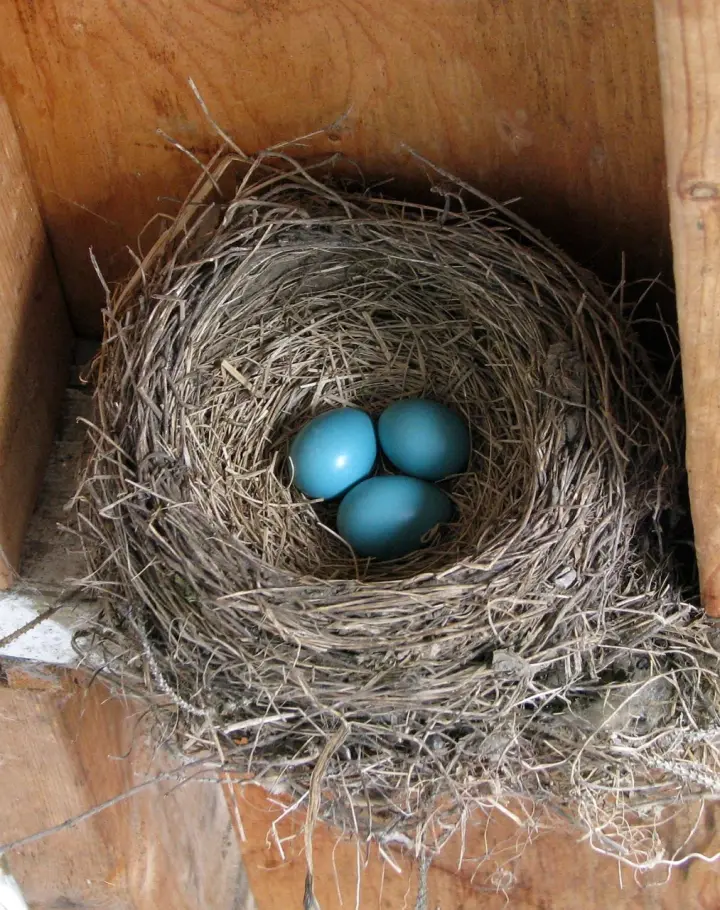
Blue eggs get the most questions, and several backyard birds lay them. Plain, unmarked blue usually points to an American Robin or a bluebird. The nest settles most cases: Audubon describes a robin’s nest as a cup of grasses and twigs worked into a solid foundation of mud, on a branch or a building ledge, while bluebirds nest inside a cavity or birdhouse. Audubon also notes that bluebird eggs are sometimes white, so a white clutch in a bluebird box is not proof that another species moved in.
A Gray Catbird egg runs greener, which Audubon describes as greenish blue, and the nest sits low in dense shrubs or briars. Blue eggs with dark dots or scrawls are a different group. House Finch eggs are pale blue with black and lavender dots, and Chipping Sparrow eggs are pale blue-green with brown, purple, and black markings, both concentrated at the larger end. If you find pale bluish white eggs in a tight cup in July or August, think of the American Goldfinch, the late nester NestWatch singles out.
Speckled Bird Egg Identification: White and Brown Speckled Eggs
Speckled bird egg identification is harder, because many small birds lay white or pale eggs with brown spots. Here the nest site does most of the work:
- In a cavity or nest box: Black-capped Chickadee (white with fine reddish brown dots), Carolina Wren (white with brown blotches), Northern House Wren (white, heavily dotted with reddish brown), and House Sparrow (whitish to greenish white with brown and gray dots). Audubon notes that a female chickadee covers her eggs with nest material when she leaves the nest, so the eggs may be hidden from a quick look.
- In an open cup in a shrub: Northern Cardinal (whitish to pale bluish or greenish white, marked with brown, purple, and gray) and Northern Mockingbird (greenish to bluish gray with brown blotches).
- On or near the ground: Song Sparrow, whose pale greenish white eggs are heavily spotted with reddish brown, and Killdeer, whose buff eggs are blotched with black and brown and sit in a bare scrape.
- In a mud cup on a building: Barn Swallow, with white eggs spotted with brown. The Eastern Phoebe also builds a mud-based nest on structures, but its eggs are white with at most a few dots.
Clutch size helps separate the cavity nesters. Audubon lists six to eight eggs as usual for the Black-capped Chickadee and six to seven for the Northern House Wren, more than most open-cup nesters in the chart lay.
The Odd Egg Out: Brown-headed Cowbirds
If one egg in a clutch looks different from the rest, a cowbird may be the reason. Audubon describes the Brown-headed Cowbird as a brood parasite that builds no nest and lays its eggs in the nests of other birds, which raise the young. Its eggs are whitish with brown and gray spots concentrated at the larger end. According to Audubon, a female may lay nearly one egg per day for several weeks, often removes an egg from the host nest before laying her own, and has been recorded laying in the nests of more than 220 species. Some hosts fight back: Audubon says Gray Catbirds usually puncture and eject cowbird eggs.
Resist the urge to help. NestWatch explains that Brown-headed Cowbirds are native to North America and protected by the Migratory Bird Treaty Act, and that tampering with their eggs or young is against federal law unless you hold a special permit.
Look, Do Not Touch: What the Law Says
The U.S. Fish and Wildlife Service page on bird nests says most bird nests are protected under the Migratory Bird Treaty Act, and quotes the rule: no person may take, possess, import, export, transport, sell, purchase, barter, or offer for sale any migratory bird, or the parts, nests, or eggs of such bird, except as permitted under a valid permit. The same page says it is illegal to destroy a nest that has eggs or chicks in it, or while young birds still depend on it.
The law covers native species. The Fish and Wildlife Service explains that a 2004 amendment limited the act to birds native to the United States and requires the agency to publish a list of nonnative, human-introduced species the act does not apply to. Because protection depends on the species and on state rules, treat every nest as protected unless a wildlife agency tells you otherwise, and read the agency’s own guidance rather than relying on a summary like this one.
Even where the law is not the issue, moving eggs rarely works out. NestWatch says an active nest should stay where it is until the birds fledge, because moving it even a few feet stresses the birds, risks injury to the eggs, and often leads the adults to abandon it. To identify eggs without causing trouble:
- Look quickly and step away. NestWatch advises against bringing attention to a nest, trampling the plants around it, or checking it in bad weather.
- Use binoculars or a phone camera from a distance rather than parting branches.
- Never handle an egg to look at the other side. If the markings you can see do not settle it, wait for the parents to return.
Found an Egg, a Fallen Nest, or a Baby Bird?
You cannot tell by looking whether an egg on the ground is still viable, so treat it like any other egg in this guide and leave it where it is. If you are not sure whether an egg or a nest is still active, leave both alone and call a licensed wildlife rehabilitator or your state wildlife agency. For reference, the Fish and Wildlife Service salvage authorization covers picking up migratory birds found dead, including nonviable eggs and inactive nests, only to donate or destroy them within seven calendar days, and says salvaged specimens may not be kept for personal use.
A fallen nest with eggs or chicks in it is a call for help, not a home project. NestWatch says not to try to care for the egg or young yourself, and to call a federally certified wildlife rehabilitator or a wildlife veterinarian; your state wildlife agency is another place to call. For a young bird on the ground, NestWatch’s first question is whether it is a fully feathered fledgling, which should be left alone because the parents are likely nearby, or a nestling with bare skin, which needs different help.
Eggs in a Nest Box
Nest boxes hold many of the eggs in this chart. Audubon lists birdhouses or nest boxes as nest sites for Eastern and Western Bluebirds, Tree Swallows, Black-capped Chickadees, Carolina and Northern House Wrens, and House Sparrows. Whether you build your own box or compare the best birdhouses for sale, the eggs inside are often the quickest way to learn who moved in.
A box can also look abandoned when it is not. NestWatch says adults often seem to disappear once the nest is built, because the female visits only once a day to lay an egg, and then both parents keep activity low while incubating. For a nest with eggs, NestWatch suggests allowing four weeks with no adults and no progress before deciding a nest is abandoned. Only once a nest is inactive, meaning no viable eggs or live young, does NestWatch say it is legal to clean it out.
When a box or shrub holds a nest but no eggs yet, bird nest identification relies on materials and shape instead. NestWatch points to nest composition (mud, moss, grasses, sticks) and shape (cup, dome, platform, hanging pouch) as the main clues.
How We Put This Guide Together
This guide is based on published sources, not on nests we monitor ourselves. Egg colors, clutch sizes, incubation periods, and nest sites come from the Audubon field guide entry for each species. Identification steps and nest-handling advice come from NestWatch, and legal points come from U.S. Fish and Wildlife Service pages. NestWatch also publishes a clutch size and incubation chart based on other references; its averages are close to Audubon’s but not always identical, so we used one source throughout the table. Our general method is on the How We Review page.
Bird Egg Identification: FAQ
What backyard bird lays blue eggs?
Several do. In the Audubon field guide, American Robin, Eastern Bluebird, and Western Bluebird eggs are plain pale blue; Gray Catbird eggs are greenish blue; House Finch eggs are pale blue with black and lavender dots; and Chipping Sparrow eggs are pale blue-green with darker markings. Blue Jay eggs are sometimes pale blue but are usually spotted. Use the nest site to decide: a mud-based cup on a branch or ledge suggests a robin, a cavity or birdhouse suggests a bluebird.
What bird lays white eggs with brown speckles?
Many small birds do, including the Black-capped Chickadee, Carolina Wren, Northern House Wren, House Sparrow, Barn Swallow, and Brown-headed Cowbird, per Audubon. Start with where the nest is. Inside a cavity or nest box, think chickadee, wren, or House Sparrow; in a mud cup under an eave, a Barn Swallow; a single odd egg in another bird’s nest may be a cowbird’s.
Can I pick up a bird egg to look at it or put it back in the nest?
Leave it alone. The Migratory Bird Treaty Act bars taking or possessing the eggs of protected native birds without a permit, according to the U.S. Fish and Wildlife Service, and NestWatch says active nests should stay undisturbed until the young fledge. Identify the egg from a distance, and if a nest with eggs has fallen, contact a licensed wildlife rehabilitator or your state wildlife agency.
Can I keep a wild bird egg I found?
Not the egg of a native species. Leave it where it is, and if you cannot tell whether it or its nest is still active, call a licensed wildlife rehabilitator or your state wildlife agency. The Fish and Wildlife Service salvage authorization says salvaged specimens, including nonviable eggs, may not be kept for personal use and must be donated or destroyed within seven calendar days.
How long do backyard bird eggs take to hatch?
For most small songbirds in the chart, Audubon lists roughly 11 to 18 days of incubation, such as 12 to 14 days for the American Robin and about 14 days for the Mourning Dove. Ground-nesting Killdeer take longer, 24 to 28 days. NestWatch says one or both parents begin incubating once the entire clutch is laid, so the count starts later than the first egg.
Is a nest abandoned if I never see the parents?
Probably not. NestWatch says parents keep activity low during incubation to avoid drawing predators, and recommends waiting about four weeks from the last time you saw an adult before deciding a nest with eggs was abandoned.
Final Thoughts
Egg color starts the search, but the nest site, the clutch size, and the season usually finish it. Read the chart with all four clues, watch for the parents from a distance, and leave the eggs exactly where they are. More guides to nest boxes and the birds that use them are in our Birdhouses section.
About the author

Steve Stephens is an Oregon-based gardener and birdwatcher who has spent seven years creating bird-friendly outdoor spaces. Steve's interests include observing seasonal hummingbird visits, maintaining bird baths, and choosing nest boxes suited to local species. Drawing on a background in garden retail, Steve writes practical guides to hummingbird feeders, bird baths, and birdhouses, with attention to placement, cleaning, and maintenance.