
Hawk at Bird Feeder? How to Keep Hawks Away Without Harming Them
A hawk at your feeder is hunting the songbirds. Here is how to make the yard a worse hunting ground without harming a federally protected bird.
 Updated November 3, 2026
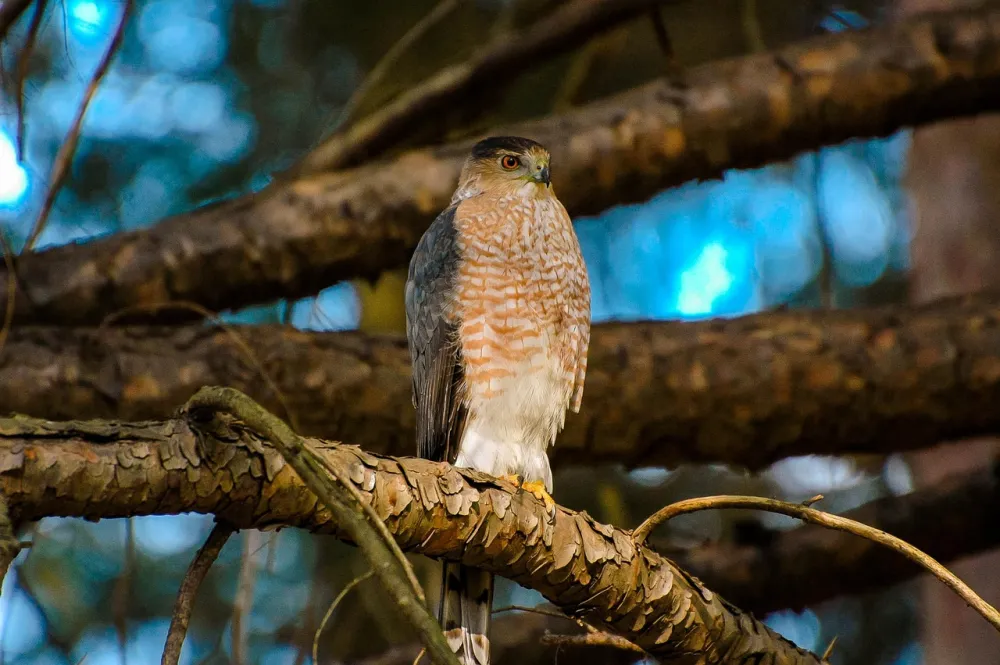
A hawk at bird feeder stations is almost always there for the birds, not the seed. In most backyards it is a Cooper’s Hawk or a Sharp-shinned Hawk, and Penn State Extension says both are drawn by the concentration of small birds a feeder creates. The fixes that published wildlife sources agree on are simple and do not harm the hawk: take the feeders down for a few days, give small birds dense cover to dive into, and arrange the feeding area so birds are less exposed. Hawks are protected under federal law, so trapping, poisoning, or injuring one is off the table.
This guide covers non-harmful steps only and is not legal advice. If you find an injured hawk or songbird, do not try to handle it; contact a licensed wildlife rehabilitator or your state wildlife agency.
Hawk at Bird Feeder: Why It Happens
A feeder gathers many small birds in one predictable spot, and that is exactly what a bird-eating hawk looks for. Penn State Extension puts it plainly: the hawk is attracted by the concentration of food, “but in this case, the food is the birds themselves.” The Missouri Department of Conservation adds that Cooper’s Hawks often learn to hunt birds attracted to backyard feeders, and that they may visit feeders in winter for that reason.
Visits have become more common over the decades. The National Wildlife Federation reports that Project FeederWatch participants found Cooper’s Hawks at 6.4 percent of feeders in 1989 and at 21.9 percent 25 years later. The same article notes that both Cooper’s and Sharp-shinned Hawks hunt small and medium-sized birds, the size of most feeder birds, and also take mice and chipmunks that come for spilled seed.
Which Hawk Is It? Cooper’s vs. Sharp-shinned
The two feeder hawks look alike. According to the Audubon field guide entry for Cooper’s Hawk, adults of both are blue-gray above and pale reddish below, while young birds are brown above and streaked below. The Cooper’s Hawk is larger, about 15 to 18 inches long, with a relatively bigger head, longer tail, and thicker legs. Its tail tip is more rounded and often shows a wider white tip, and adults usually show a more obvious dark cap.
The Sharp-shinned Hawk is 10 to 14 inches long, with a tail tip that usually looks squared off, a small-headed look, and pencil-thin legs. Audubon cautions that a female Sharp-shin can be almost as big as a male Cooper’s, so size alone can mislead. Both hunt by stealth from dense cover, then burst out at high speed. A big, bulky hawk on a utility pole may be a Red-tailed Hawk, which Audubon describes as commonly perched on roadside poles and hunting mostly from a high perch, with small mammals often its main prey.
Hawks Are Protected by Federal Law
The Migratory Bird Treaty Act, administered by the U.S. Fish and Wildlife Service, prohibits the “take” of protected migratory bird species without prior authorization, and the agency defines take as including killing, capturing, selling, trading, and transport. Cooper’s Hawk, Sharp-shinned Hawk, and Red-tailed Hawk all appear on the USFWS list of birds protected by the act.
The Indiana Department of Natural Resources says hawks are regulated by state and federal laws that prevent their capture, killing, or possession without a special permit. The National Wildlife Federation’s advice for homeowners is shorter: never harm or harass hawks. State rules differ, so if you have a question about a specific situation, ask your state wildlife agency or the U.S. Fish and Wildlife Service rather than acting on a guess.
How to Keep Hawks Away From Bird Feeders Without Harming Them
Every step below comes from a wildlife agency, extension service, or conservation group. None of them hurts the hawk; they make the yard a worse hunting ground or give small birds a better chance to escape.
1. Take the Feeders Down for a While
This is the step every source mentions. Penn State Extension suggests taking feeders down for a couple of days, after which “the hawk will eventually look elsewhere for food.” The Missouri Department of Conservation says a few days or a couple of weeks. The National Wildlife Federation suggests closing feeders for about a week, and closing them again for longer if the hawk returns after you reopen. Indiana DNR notes that in winter a hawk will typically stay in an area for only two or three weeks before moving on.
A practical approach: empty and bring in every feeder for about a week, sweep up spilled seed so birds do not keep gathering on open ground, then put one feeder back and watch. If the hawk reappears within a day or two, take the feeders down again for two weeks or more, as the National Wildlife Federation suggests for a returning hawk.
2. Give Small Birds Cover to Dive Into
Penn State Extension calls cover “the best way to protect songbirds from raptors”: a well-planted yard gives small birds a place to hide when a hawk is near. The National Wildlife Federation recommends shrubs, especially evergreens, near feeders, and brush piles about 8 feet wide and 4 feet high placed no more than 20 feet from the feeders. The Maryland Department of Natural Resources gives the same advice, to place feeders near shrubs or cover, with one exception: feeders on or near the ground.
In a small yard, that can be as simple as one dense evergreen shrub within a few steps of the feeder pole instead of a feeder in the middle of open lawn. On an apartment balcony there is little room for cover, so the other steps on this list carry more of the load.
3. Move Feeders Close to Windows and Mark the Glass
The National Wildlife Federation points out that birds fleeing a hawk can hit windows, and a stunned bird is easy prey. It suggests adding “visual noise” such as bird-warning decals or screens to the outside of reflective windows and sliding doors, and moving feeders to within 3 feet of the window so a bird cannot build up speed before reaching the glass. Window distance is only one part of feeder placement, which also involves squirrels, cats, and how much you can see from inside.
4. Make the Feeding Area Harder to Spot
Hawks are drawn by the sight of activity at the feeder. The National Wildlife Federation suggests keeping feeder visitors out of view where you can: tarps or even umbrellas over the feeding area, feeders with roofs, or covers that cannot be seen through.
5. Stop Scattering Seed on the Ground
According to the National Wildlife Federation, birds eating on the ground are especially vulnerable to hawk attacks because they react more slowly and have fewer escape routes. Its suggestion is a hanging platform feeder for ground feeders such as sparrows and doves, so they eat off the ground and closer to cover.
6. Add a Wire Cage or Low Fencing
Wire-caged feeders made to keep out larger birds such as jays may also help small birds dodge hawks, according to the National Wildlife Federation. It also mentions that some people put up 4-foot-high rabbit fencing so a hawk cannot swoop down onto birds feeding on the ground.
Is There a Hawk Proof Bird Feeder?
None of the sources reviewed for this guide describes a feeder that keeps hawks away on its own. The closest thing is the caged feeder, which the National Wildlife Federation says “may also help” small birds escape, and a roofed or covered feeder that hides activity. No feeder changes the basic situation the sources describe: small birds gathered where a hawk can see them. Keep in mind that squirrel-proof feeders are designed to stop squirrels, not hawks.
Hawk in Bird Bath: What It Means
Hawks drink and bathe too. Project FeederWatch has posted participant photos of a Cooper’s Hawk that stayed in an in-ground birdbath for about 12 minutes and of a juvenile Cooper’s Hawk drinking from a birdbath next to a hummingbird feeder. A hawk bird bath visit means the hawk is using the water the same way other birds do.
Bath placement does affect how safe small birds feel. The FeederWatch handout Providing Water for Birds explains that birds cannot fly well when they are wet, so they are vulnerable while bathing, and cover nearby lets them escape a cat or a hawk. UF/IFAS Extension Leon County says cats cannot easily ambush birds at a bath set in the middle of a lawn, but birds will probably ignore it, possibly because it leaves them too exposed to aerial predators. It suggests overhanging branches within two or three feet for wet birds to escape into and low shrubs about 10 feet away. Those trade-offs apply to bird bath placement generally.
What Not to Do
- Do not trap, capture, shoot, poison, or try to injure a hawk. The Migratory Bird Treaty Act prohibits take of protected species without authorization from the U.S. Fish and Wildlife Service.
- Do not chase or harass the hawk. The National Wildlife Federation advises never to harm or harass hawks. Indiana DNR does list visual scare devices for hawks causing problems, but says the relief may be only temporary; the steps above are the cautious choice for a backyard feeder.
- Do not pick up an injured or grounded hawk. Call a licensed wildlife rehabilitator or your state wildlife agency.
- Do not keep tossing extra seed on the ground while a hawk is around. That concentrates the most vulnerable birds in the most open spot.
Living With the Occasional Hawk
Seeing a chickadee taken at your feeder is hard to watch, but the sources agree that it is part of a working ecosystem. Penn State Extension says that on a population level hawks have little, if any, negative effect, because hawks are few compared with feeder birds and their hunting success is low; it calls hawks “a natural part of the ecosystem” and a sign of a healthy environment. In the National Wildlife Federation article, FeederWatch’s project leader says there is no evidence that hawks have caused declines in any prey species taken at feeders. The Missouri Department of Conservation notes that an abundance of accipiters is usually a sign of good health for other bird populations.
Indiana DNR frames it as a choice: if hawks at the feeder upset you, take the feeders down until the hawk moves on, but this kind of predation is natural, and it can be a learning experience for anyone who leaves the feeder out. The National Wildlife Federation notes that many backyard birders are glad to watch these predator and prey interactions without leaving home.
Frequently Asked Questions
How do I stop hawks from killing birds at my feeder?
You cannot stop every attack, but you can lower the odds. Take the feeders down for about a week, add dense shrubs or a brush pile close to the feeders, stop feeding on open ground, and consider a wire-caged feeder for small birds. These are the measures recommended by Penn State Extension and the National Wildlife Federation.
How long should I take my bird feeders down when a hawk is around?
The sources range from a couple of days (Penn State Extension) to a few days or a couple of weeks (Missouri Department of Conservation) to about a week, longer if the hawk returns (National Wildlife Federation). A week is a reasonable start. If the hawk shows up again soon after you refill, take them down for two weeks or more.
Will a hawk keep coming back to my feeder?
It may. Missouri’s conservation department says Cooper’s Hawks often learn to hunt at backyard feeders. Indiana DNR notes that in winter a hawk typically stays in an area for only two or three weeks before moving on, so a feeder break that long often outlasts the visit.
Is it legal to trap or scare off a hawk at my feeder?
Trapping or capturing a hawk is take under the Migratory Bird Treaty Act, which requires prior authorization from the U.S. Fish and Wildlife Service. This guide does not give legal advice; for questions about your situation, contact your state wildlife agency or USFWS. For a backyard feeder, the non-harmful steps above are enough.
Final Thoughts
A hawk at the feeder means your yard is full of birds, which is the point of feeding them. If the visits bother you, take the feeders down for a week, plant or pile cover nearby, keep feeding off the ground and close to the house, and let the hawk find another hunting spot. Never trap or harm it: hawks are federally protected, and they belong in a healthy backyard as much as the songbirds do. For more on feeder types and setups, browse the Bird Feeders section.
About the author

Eric Hunter is a North Carolina-based backyard birding enthusiast with nine years of experience observing birds and maintaining feeding stations. A freelance editor by trade, Eric combines an interest in bird behavior with practical research into feeders, seed mixes, and mounting accessories. As Editor-in-Chief, Eric oversees editorial standards and reviews articles for clarity, reliable sourcing, and useful guidance for backyard birders.