
Best Hummingbird Nectar (and Is Store-Bought Worth It?)
Five hummingbird nectar mixes compared on sweetener, added color, and mixing directions, plus when plain homemade sugar water is the better choice.
 Updated October 27, 2026
The best hummingbird nectar is plain sucrose and water with no added color. All five products in this guide are mixes or concentrates that you dilute at home, and the useful differences between them come down to what is in the package, how you measure it, and whether the maker added color. Only one of the five lists no dyes at all, so we say plainly where each product departs from that standard. This guide also explains when buying nectar makes sense and when it does not, and what to check on any label before you fill a feeder.
One point up front, because it shapes every pick below: both the National Audubon Society and Smithsonian’s National Zoo publish a homemade recipe of refined white sugar and water, and both advise against red coloring. Keep that standard in mind as you read the picks below.
This guide covers choosing nectar for backyard feeders. It is not advice on caring for sick or injured birds; if you find one, contact a licensed wildlife rehabilitator or your state wildlife agency.
We earn a commission from qualifying purchases made through links on this page. Commissions never affect our rankings or FeederBirdLab Scores.
Our Top Hummingbird Nectar Picks
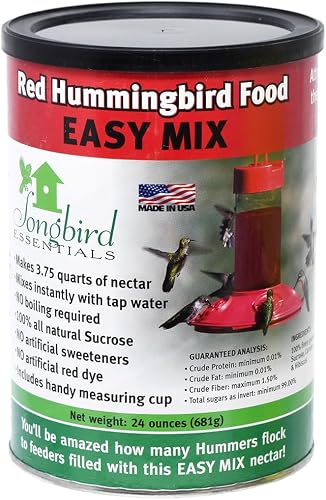
- Best Overall: Songbird Essentials Red Hummingbird Nectar Mix. A dry mix the listing describes as 100% sucrose with no artificial sweeteners or artificial red dye, and no boiling step.
- Best Liquid Concentrate: First Nature 3054 Red Hummingbird Nectar Concentrate. The only pour-and-dilute liquid here (the others are mixes you dissolve); the listing says one bottle makes about a gallon of nectar.
- Best for Hummingbirds and Orioles: Birds Choice Hummingbird and Oriole Nectar Concentrate. The only listing here with a stated oriole yield as well as a hummingbird yield, and it lists no dyes. The Audubon Park listing also mentions orioles but gives no mixing amounts.
- Best Pre-Measured Packets: Audubon Park 1661 Hummingbird Nectar Packets. Six pre-measured 3 oz packets, so there is nothing to scoop; colored with cochineal and annatto, per the listing.
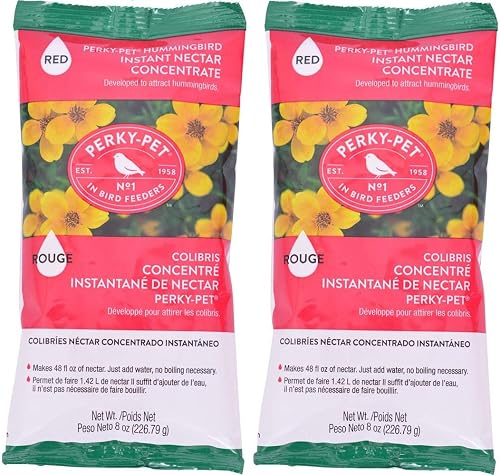
The fifth product, Perky-Pet 230 Instant Hummingbird Nectar, passed our sales, brand, and owner-rating checks and makes a clear sucrose-only ingredient claim, but it is red and does not stand out on any measure we could compare, so it carries no title.
Hummingbird Nectar Compared
| Product | Form | Nectar per package (per listing) | Added color (per listing) | Sweetener (per listing) |
|---|---|---|---|---|
| Songbird Essentials Red Nectar Mix, 24 oz | Instant powder | Up to 3.75 quarts in one section, 4.5 quarts in another | Labeled “Red”; no artificial red dye listed | 100% sucrose |
| First Nature 3054 (32 oz) | Liquid concentrate | About 1 gallon (128 oz) | Described as bright red, and elsewhere as red dye-free | Sucrose |
| Birds Choice Nectar Concentrate, 3 x 24 oz | Concentrate, dissolves in water | 3.75 quarts hummingbird nectar or 5.25 quarts oriole nectar per pouch | No dyes listed | Pure sucrose |
| Audubon Park 1661, 6 x 3 oz packets | Powder packets | Not listed | Cochineal extract (carmine) and annatto | Not listed |
| Perky-Pet 230 Instant Nectar, 2 x 8 oz | Instant powder | 48 ounces per bag | Red | 100 percent sucrose |
Our ranking reflects our overall assessment of specifications, maker information, and owner reviews. The FeederBirdLab Score is a separate measure based on Amazon customer ratings with a limited editorial adjustment, and it does not set the order.
| Product | FeederBirdLab Score About FeederBirdLab ScoreThe FeederBirdLab Score is our own rating out of 10. It starts from the average Amazon customer rating, may be adjusted by the editor by up to 0.5 points, and is never influenced by brands, retailers, or affiliate commissions. Learn more › | |
|---|---|---|
 Songbird Essentials Red Hummingbird Nectar Mix |
8.6/10 | Buy |
 First Nature 3054 Red Hummingbird Nectar Concentrate |
8.4/10 | Buy |
 Birds Choice Hummingbird and Oriole Nectar Concentrate (3-Pack) |
8.6/10 | Buy |
 Audubon Park 1661 Hummingbird Nectar Packets (2 Boxes) |
8.6/10 | Buy |
 Perky-Pet 230 Instant Hummingbird Nectar (2-Pack) |
8.6/10 | Buy |
Songbird Essentials Red Hummingbird Nectar Mix
A dry instant mix for people who refill feeders often and want to skip the boiling step. According to the Amazon listing, it is 100% sucrose, has no artificial sweeteners or artificial red dye, and dissolves in warm or cool tap water. The listing gives two different batch yields for one can (up to 3.75 quarts in one section, 4.5 quarts in another), so measure by the label on the can. Look elsewhere if you want a nectar sold as clear: this one is labeled "Red," and the listing does not say what that word refers to.
Pros
- No boiling step, per the listing
- Listed as 100% sucrose with no artificial sweeteners or artificial red dye
- 24 oz can; the listing gives yields of 3.75 to 4.5 quarts
Cons
- Listing gives two different batch yields
- Labeled "Red" without saying what the word refers to
First Nature 3054 Red Hummingbird Nectar Concentrate
The only pour-and-dilute liquid in this guide, for people who would rather pour and dilute than measure powder. The Amazon listing says the 32 oz bottle makes about a gallon of nectar and that the formula is sucrose with no artificial preservatives. The same listing contradicts itself on mixing (one part concentrate to three parts water in one section, four parts water in another) and on color (described as bright red, and elsewhere as red dye-free), so follow the directions printed on the bottle. Look elsewhere if you want nectar with no coloring.
Pros
- Liquid concentrate, nothing to dissolve
- About a gallon of nectar per bottle, per the listing
- Sucrose formula with no artificial preservatives listed
Cons
- Listing gives two different mixing directions
- Red color with no stated source
Birds Choice Hummingbird and Oriole Nectar Concentrate (3-Pack)
A pure-sucrose mix with no listed dyes, for yards that feed both hummingbirds and orioles. According to the Amazon listing, it contains no dyes, preservatives, or additives, and each 24 oz pouch makes 15 cups (3.75 quarts) of hummingbird nectar or 21 cups (5.25 quarts) of oriole nectar. It ships as a three-pack of resealable pouches, which fits a full feeding season better than a single small feeder. Look elsewhere if you run one small feeder and do not want to store several pouches.
Pros
- Listed with no dyes, preservatives, or additives
- Separate mixing yields for hummingbirds and orioles
- Resealable pouches
Cons
- A three-pack is more than a one-feeder yard needs
- Listing does not say whether the concentrate is dry or liquid
Audubon Park 1661 Hummingbird Nectar Packets (2 Boxes)
Pre-measured 3 oz packets for people who do not want to measure anything. The Amazon listing says the powder has no preservatives and is colored with cochineal extract (carmine) and annatto, which it calls all-natural colors. Audubon Park is a brand name; nothing in the listing ties it to the National Audubon Society. Several owners on this listing say it is easy to mix and that hummingbirds like it; one owner who ran it next to plain sugar water reported that the birds preferred the sugar water. Look elsewhere if you want nectar with no added color at all.
Pros
- Pre-measured packets, nothing to scoop
- No preservatives, per the listing
- Small boxes suit occasional feeding
Cons
- Contains added color (cochineal and annatto)
- Listing does not say how much nectar each packet makes
Perky-Pet 230 Instant Hummingbird Nectar (2-Pack)
A two-bag instant mix for people who want a plain powder with no boiling step. According to the Amazon listing, each 8 oz bag makes 48 ounces of nectar, the powder is 100 percent sucrose with no artificial sweeteners, it needs no boiling, and it is red. Most owners on this listing say hummingbirds like it; one owner said a batch came out maroon and the birds did not drink it. Look elsewhere if you want clear nectar.
Pros
- No boiling, per the listing
- 100 percent sucrose with no artificial sweeteners listed
- Each bag makes 48 ounces of nectar
Cons
- Red colored nectar
- One owner reported an off-color batch the birds avoided
How We Chose
We started with every hummingbird nectar, nectar concentrate, and nectar mix we could find from Amazon US searches for the main product terms, then removed anything that was not nectar itself (feeders, ant moats, and cleaning brushes turn up in the same results). Each remaining product had to be sold new, carry a rating of at least 4.0 out of 5 with at least 30 owner ratings, and come from a brand on our reviewed list for this category. Listings whose manufacturer field named a different company than the brand on the label were removed.
We then read each listing in full: ingredients, mixing directions, batch yield, and any statement about color. Where a listing contradicted itself, we say so rather than pick the more flattering number. When two listings were the same nectar in different bottle sizes, we kept one listing, so you see five different products rather than one product twice. Best Overall has to list sucrose as the sweetener, need no boiling, come from a brand we have vetted, and average at least 4.2 out of 5 on a substantial number of owner ratings. Songbird Essentials meets all of that: it is an instant powder in a single 24 oz bag, and the listing describes it as 100% sucrose with no artificial sweeteners or artificial red dye. The other four products follow our research order for this guide, which weighs ingredients and how easy each product is to measure correctly. The FeederBirdLab Score on each card is a separate measure and does not decide that order; see how the score is calculated. Birds Choice has the plainest ingredient statement of the five; choose it first if a listing that states no dyes matters most to you. Our full method is on the How We Review page.
Is Store-Bought Hummingbird Nectar Worth It?
For many yards, no. The homemade version that Audubon and the National Zoo both describe uses one part refined white sugar to four parts water, which works out to a quarter cup of sugar per cup of water in Audubon’s recipe. The National Zoo adds that you should never use honey, corn syrup, or raw, unprocessed sugars, and Audubon warns that honey can promote dangerous fungal growth. If you already keep white sugar in the kitchen, mixing your own nectar may suit you better than any packaged mix.
Store-bought nectar still makes sense in a few situations:
- You refill several feeders and want the same strength every time. A pre-measured packet or a scoop-and-stir mix removes guesswork when more than one person in the household fills feeders.
- You want to skip the boiling step. Four of the five products here describe a no-boil mix on their listings.
- You feed orioles too. The Birds Choice listing gives a separate, more dilute oriole yield from the same pouch, which saves you from working out a second recipe.
- You fill feeders away from a kitchen, such as at a cabin or a community garden, where carrying a liquid concentrate or packets is easier than carrying sugar and a measuring cup.
We found no evidence in the listings we reviewed that store-bought nectar draws more hummingbirds than correctly mixed sugar water, so we do not rank on that kind of promise.
How to Choose Hummingbird Nectar
Read the sweetener line first
The homemade standard is table sugar, which is sucrose. Four of the five listings here state sucrose as the sweetener, and three of them say 100% sucrose. If a mix lists other sugars, sweeteners, or a long ingredient panel, compare it against the plain recipe before you buy. A nectar that cannot tell you what sweetens it is not worth the convenience.
Decide how you feel about color
Color is where the listings differ most. Audubon says red food coloring is not necessary and could prove harmful to birds, and the National Zoo says not to add red dye. Several mixes are still red. In this guide, the Audubon Park packets list cochineal extract and annatto as natural colors, Perky-Pet describes its nectar as red, and First Nature calls its concentrate bright red while also calling it red dye-free, without naming what makes it red. Birds Choice is the one listing that states no dyes at all, and Songbird Essentials states no artificial red dye. If you want to follow the published guidance, choose a mix that lists no color.
Match the form to how you fill feeders
Powder mixes store in a small space and let you make as little or as much as you need. A liquid concentrate is faster to pour but heavier to store, and you dilute it rather than dissolve it. Packets are the easiest to measure but run out fastest. Think about the size of your hummingbird feeder: a small window feeder that holds a few ounces does not need a gallon of mixed nectar at a time, and mixed nectar does not keep forever.
Check that the mixing directions agree with themselves
Two listings in this guide give conflicting numbers. The Songbird Essentials listing states two different batch yields for the same can, and the First Nature listing gives two different water ratios for the same concentrate. That does not make either product bad, but it does mean you should follow the directions printed on the package you receive, not a number copied from a product page.
Buy an amount you will use while it is fresh
Mixed nectar spoils in a warm feeder, which is why the National Zoo advises changing feeders every other day and cleaning them thoroughly each time to prevent harmful mold growth. Buying a large pack only helps if you will actually mix fresh batches that often. A three-pack of pouches suits a busy yard through a full season; a single box of packets suits a yard with one feeder and occasional visitors.
Who Should Look Elsewhere
Skip store-bought nectar if you already measure sugar and water comfortably. Skip the red products in this guide if you want to follow the guidance against added coloring. Skip the Birds Choice three-pack if you have a single small feeder and limited storage space, and skip the Audubon Park packets if you fill several large feeders, because the listing does not say how much nectar each packet makes.
If the feeder is the problem rather than the food (it leaks, drips, or is hard to scrub), replace the feeder before you change what goes in it.
Hummingbird Nectar FAQ
What should I look for on a hummingbird nectar label?
Three things: sucrose as the only sweetener, no added color, and directions that give one ratio and one batch size. The How to Choose section above covers each point in detail.
Is a powder mix or a liquid concentrate better?
Both recipes we cite are simply sugar and water, so a plain sucrose product in either form can meet that standard once mixed. Powder takes less space and lets you mix small batches; liquid concentrate is quicker to pour. Choose the form that matches how many feeders you fill and how often.
Can I use hummingbird nectar in an oriole feeder?
Some products are sold for both. The Birds Choice listing gives a hummingbird yield of 3.75 quarts and an oriole yield of 5.25 quarts from the same pouch, which means it is mixed more dilute for orioles. If your product does not give an oriole ratio, follow the oriole feeder maker’s directions rather than guessing.
Do hummingbirds need nectar with added vitamins or electrolytes?
Neither the Audubon recipe nor the National Zoo recipe includes vitamins or electrolytes; both are sugar and water. Several listings in this guide make general health claims that we could not verify, and none lists vitamins or electrolytes as an ingredient, so we did not rank any product on added ingredients. If a product does advertise additives, ask what it adds beyond the plain recipe before paying for it.
Final Thoughts
If you buy hummingbird nectar rather than make it, buy the plainest one that fits how you fill feeders. Our picks by need:
- Best Overall: Songbird Essentials Red Hummingbird Nectar Mix, for a no-boil powder that, per the listing, is 100% sucrose with no artificial red dye.
- Best Liquid Concentrate: First Nature 3054 Red Hummingbird Nectar Concentrate, if you prefer to pour and dilute.
- Best for Hummingbirds and Orioles: Birds Choice Hummingbird and Oriole Nectar Concentrate, the only listing here that states no dyes along with a separate oriole yield.
- Best Pre-Measured Packets: Audubon Park 1661 Hummingbird Nectar Packets, if you want pre-measured packets and nothing to scoop.
Whichever you choose, change the nectar often and keep the feeder clean, as the National Zoo advises. For feeders, ant moats, and related guides, see our Hummingbird Feeders section.
About the author

Steve Stephens is an Oregon-based gardener and birdwatcher who has spent seven years creating bird-friendly outdoor spaces. Steve's interests include observing seasonal hummingbird visits, maintaining bird baths, and choosing nest boxes suited to local species. Drawing on a background in garden retail, Steve writes practical guides to hummingbird feeders, bird baths, and birdhouses, with attention to placement, cleaning, and maintenance.