
Best Suet for Bird Feeders: 7 Suet Cakes and Balls for Woodpeckers
Seven suet cakes and balls compared on shape, size, ingredients, pack size, and warm-weather claims, plus when to take suet down for the summer.
 Updated November 1, 2026
The best suet for bird feeder use is a processed suet cake or ball that fits the feeder you already own and holds up to the weather you feed in. Our pick is the Wildlife Sciences Melt Resistant Suet Balls variety pack: 16 balls about 2.5 in across, in four flavors and four wrapped packs, with a melt-resistant formula according to the Amazon listing and Wildlife Sciences’ own product pages. Balls need a ball feeder, though one owner simply cuts them in half for a square cage. If you want square cakes, the other six picks below are cakes, and we say which suits which yard.
We compared the seven on shape and size, what is in them, how many come in a pack, what each listing claims about warm weather, and what owners report where a listing has owner reviews. Product details come from each Amazon listing or the maker’s own product page, and we say which. Feeding advice comes from Audubon, the National Wildlife Federation, Project FeederWatch, and Penn State Extension, linked where we use them, and where they disagree we say so and lead with the more cautious advice.
This guide covers choosing suet for backyard feeders. It is not advice on caring for sick or injured birds; if you find one, contact a licensed wildlife rehabilitator or your state wildlife agency.
We earn a commission from qualifying purchases made through links on this page. Commissions never affect our rankings or FeederBirdLab Scores.
Our Top Suet Picks for Bird Feeders
- Best Overall: Wildlife Sciences Melt Resistant Suet Balls Variety 16 Pack. Four flavors in four wrapped packs of four balls, the only suet balls here, with a melt-resistant formula per the listing and Wildlife Sciences.
- Best Bulk Pack: Wildlife Sciences Suet Cake Jumbo Mixed 20 Pack. Twenty cakes, 10 peanut and 10 berry, the most cakes and the most cake by weight of any pack here, according to the listing.
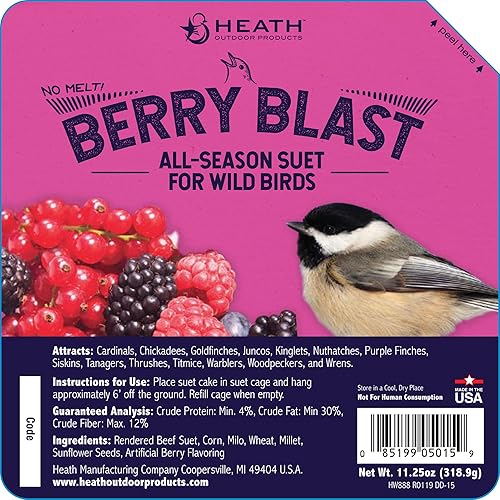
- Best Berry Blend: Heath DD-15 Berry Blast Suet Cake. The only pack here in which every cake is a berry blend, sold as a case of 12 no-melt cakes, according to the listing.
- Best Single Cake: Kaytee Suet and Seed High Energy Suet. The only listing here sold as one cake (11.75 oz, in its own tray), a low-commitment way to see which birds come.
Three cakes carry no title. The Wildlife Sciences Woodpecker cake (pecan pieces) and the Heath DD-24 Woodpecker cake (almonds and peanut parts) are both sold as woodpecker blends, per their listings, and nothing we could compare sets one ahead of the other, so neither takes a woodpecker title. The Heath DD412-10 High Energy Blend does not stand out on any detail we could compare, and one field of its listing names hot peppers as an ingredient while its title and description never mention pepper.
Suet Cakes and Balls Compared
Figures come from the Amazon listing unless a cell names the maker. Sizes and weights are per piece. The Heath website has no product pages for individual cakes, so Heath details come only from the listings.
| Product | Form and count | Size per piece | Weight per piece | Ingredients named | Warm-weather claim |
|---|---|---|---|---|---|
| Wildlife Sciences Suet Balls Variety (Wildlife Sciences) | 16 balls in 4 wrapped packs | About 2.5 in across | Pack of 4 balls is 1.0 lb (Wildlife Sciences); the listing gives 16 oz for all 16 balls | Four flavors (Fruit and Nut, Hot Pepper, Insect and Nuts, Peanut Blend), all with peanuts; raisins, chili pepper oil, or dried mealworms by flavor (Wildlife Sciences) | Melt-resistant formula (listing and Wildlife Sciences) |
| Heath DD-15 Berry Blast | 12 cakes | 5.25 x 5.25 x 1.25 in | Given as 0.75 lb in the title and 13.1 oz in another field | Berry flavoring, sunflower seeds | No melt, all-season |
| Wildlife Sciences Jumbo Mixed (Wildlife Sciences) | 20 cakes, 10 peanut and 10 berry | About 5 x 5 x 1 in | 10.5 oz (listing); 11 oz (Wildlife Sciences) | Rendered beef suet, cracked corn, black oil sunflower, peanuts, flavoring, processed grain by-products | Melt-resistant formula |
| Heath DD412-10 High Energy Blend | 10 cakes | Not listed | 11 oz | Not listed beyond “High Energy Blend”; one field names hot peppers | No melt, all-season |
| Wildlife Sciences Woodpecker (Wildlife Sciences) | 10 cakes | About 4.5 x 4.5 x 1 in | 10.5 oz (listing); 11 oz (Wildlife Sciences) | Rendered beef suet, cracked corn, millet, pecan pieces, processed grain by-products | Melt-resistant formula |
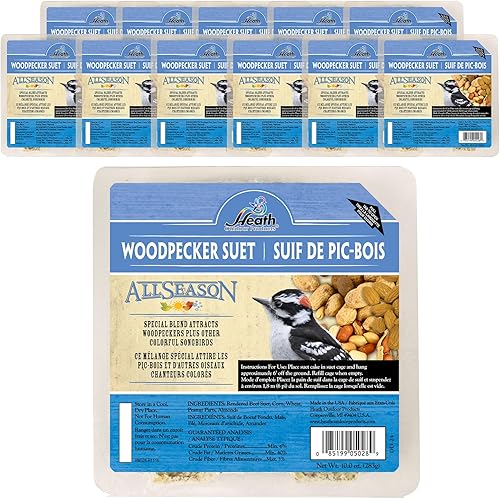
| Heath DD-24 Woodpecker | 12 cakes | 5.2 x 5.2 x 1.2 in | 10 oz | Corn, wheat, peanut parts, almonds | No melt, all-season |
| Kaytee Suet and Seed High Energy (Kaytee) | 1 cake in a tray | 5 x 5 x 1.25 in (Kaytee) | 11.75 oz (listing and Kaytee) | Rendered beef suet, corn, white millet, black sunflower (Kaytee) | None; Kaytee says it is great for year-round feeding and often preferred in warmer months because it is less messy |
Our ranking reflects our overall assessment of specifications, maker information, and owner reviews. The FeederBirdLab Score is a separate measure based on Amazon customer ratings with a limited editorial adjustment, and it does not set the order.
| Product | FeederBirdLab Score About FeederBirdLab ScoreThe FeederBirdLab Score is our own rating out of 10. It starts from the average Amazon customer rating, may be adjusted by the editor by up to 0.5 points, and is never influenced by brands, retailers, or affiliate commissions. Learn more › | |
|---|---|---|
 Wildlife Sciences Suet Balls Variety Pack |
8.6/10 | Buy |
 Heath DD-15 Berry Blast Suet Cake |
8.6/10 | Buy |
 Wildlife Sciences Jumbo Mixed 20 Pack |
8.6/10 | Buy |
 Heath DD412-10 High Energy Blend Suet Cake |
8.8/10 | Buy |
 Wildlife Sciences Woodpecker Suet Cake |
8.4/10 | Buy |
 Heath DD-24 Woodpecker Suet Cake |
8.4/10 | Buy |
 Kaytee Suet and Seed High Energy Suet |
8.4/10 | Buy |
Wildlife Sciences Suet Balls Variety Pack
For backyard birders with a suet ball feeder who want to try several flavors before settling on one. According to the Amazon listing, the pack holds 16 balls about 2.5 in across, in four wrapped packs of four: Fruit and Nut, Hot Pepper, Insect and Nuts, and Peanut Blend, all with a melt-resistant formula. Owners say the balls fit their holders and keep their shape, two mention Carolina Wrens and pileated woodpeckers among the visitors, and one cuts the balls in half to use a square cage; another says their birds were not interested. The listing gives 16 oz for all 16 balls, while Wildlife Sciences gives 1.0 lb per four-ball pack. Look elsewhere if you only own a square cage, or if you would rather avoid the chili pepper oil in the Hot Pepper pack.
Pros
- Four flavors in one order, per the listing
- Melt-resistant formula, per the listing and Wildlife Sciences
- Wrapped four-ball packs, per the listing
Cons
- Needs a ball feeder or cutting to fit a square cage
- Listing weight differs from Wildlife Sciences
Heath DD-15 Berry Blast Suet Cake
For birders who want a case of square cakes in one berry flavor. According to the Amazon listing, it is a case of 12 no-melt, all-season cakes about 5.25 x 5.25 x 1.25 in, with berry flavoring and sunflower seeds, and the listing names cardinals, chickadees, nuthatches, titmice, warblers, woodpeckers, and wrens among the birds it attracts. The listing gives the cake weight two ways (0.75 lb in the title, 13.1 oz in another field), and it does not give a full ingredient list. Look elsewhere if your cage is built tightly around a 4.5 in cake.
Pros
- Case of 12 cakes, per the listing
- No melt, all-season, per the listing
- Single berry flavor throughout
Cons
- Cake weight given two different ways
- No full ingredient list in the listing
Wildlife Sciences Jumbo Mixed 20 Pack
For yards where birds empty suet cakes quickly and buying by the case saves trips. According to the Amazon listing, it holds 20 cakes of about 5 x 5 x 1 in, 10 peanut and 10 berry, in a melt-resistant formula with rendered beef suet, cracked corn, black oil sunflower, and peanuts, made in USA. The listing gives each cake as 10.5 oz, while Wildlife Sciences lists 11 oz cakes for this pack. Look elsewhere if suet is new to your yard: 20 cakes is a lot to commit to before you know the birds will come.
Pros
- Twenty cakes, the largest pack here
- Two flavors in one case, per the listing
- Ingredients listed in full, per the listing
Cons
- Large commitment for a first try
- Cracked corn may draw sparrows and doves
Heath DD412-10 High Energy Blend Suet Cake
For birders who already use Heath cakes and want a 10-cake case. According to the Amazon listing, it holds ten 11 oz no-melt, all-season cakes made in Coopersville, Michigan, and it names cardinals, chickadees, nuthatches, titmice, woodpeckers, and wrens among the birds it attracts. The listing gives no ingredient list or cake size, and one field names hot peppers as a special ingredient that the title and description never mention. Look elsewhere if you want to know exactly what is in the cake before you buy.
Pros
- Ten 11 oz cakes, per the listing
- No melt, all-season, per the listing
- Made in Michigan, per the listing
Cons
- No ingredient list or cake size in the listing
- One field mentions hot peppers without explanation
Wildlife Sciences Woodpecker Suet Cake
For birders who want a woodpecker blend and do not mind other suet eaters joining in. According to the Amazon listing, it holds ten melt-resistant cakes of about 4.5 x 4.5 x 1 in, made with rendered beef suet, cracked corn, millet, and pecan pieces. One owner reports three kinds of woodpeckers, Carolina wrens, chickadees, and sparrows at it, another scrub jays, and one describes it as a middle ground between soft suet and hard dough; others say several cakes arrived cracked, that raccoons and deer go after it, and that the cakes are small, dry, and crumbly. Look elsewhere if sparrows already crowd your feeders, since corn and millet are in the mix.
Pros
- One owner reports three kinds of woodpeckers
- Pecan pieces in the blend, per the listing
- Little crumb waste in a cage, one owner says
Cons
- One owner calls the cakes small, dry, and crumbly
- Some cakes arrive cracked, one owner says
Heath DD-24 Woodpecker Suet Cake
For birders who want a woodpecker blend with almonds in a 12-cake case. According to the Amazon listing, each no-melt, all-season cake is about 5.2 x 5.2 x 1.2 in and 10 oz, mixed with corn, wheat, peanut parts, and almonds, and made in Coopersville, Michigan. The listing has no owner reviews we could use, so there is no owner record to set beside the maker's claims. Look elsewhere if your cage only fits a 4.5 in cake.
Pros
- Almonds and peanut parts in the mix, per the listing
- Case of 12 cakes, per the listing
- No melt, all-season, per the listing
Cons
- No owner reviews on this listing
- Too wide for a cage sized to 4.5 in cakes
Kaytee Suet and Seed High Energy Suet
For first-time suet feeders who want one cake to see which birds come, especially if they own a Kaytee Feeder Station. Per Kaytee, the 11.75 oz cake is rendered beef suet with corn, white millet, and black sunflower, measures 5 x 5 x 1.25 in, and comes in a tray that slips into the Kaytee Feeder Station; Kaytee also says it is often preferred in warmer months because it is less messy. The listing makes no melt-resistance claim. Look elsewhere if you want a case of cakes or your cage is built tightly around a 4.5 in cake.
Pros
- Single cake, an easy first try
- Ingredients listed by Kaytee
- 5 x 5 x 1.25 in, per Kaytee
Cons
- Tray is made for the Kaytee Feeder Station
- No melt-resistance claim
How We Chose
We searched Amazon US for suet cakes, suet dough, no-melt suet, multi-packs, and suet for bird feeders in general, and kept only suet itself, not feeders or seed. Each product had to be sold new, average at least 4.0 out of 5 from at least 30 owner ratings, and come from a brand on our reviewed list for bird food. Listings whose manufacturer field named a different company than the brand on the label were removed, except where we confirmed the manufacturer is the brand’s parent company, as with Kaytee. We kept no more than three products from one company, which is why there are three each from Wildlife Sciences and Heath. Two more listings titled as Wildlife Sciences cakes were left out because the brand name on them is one we could not confirm belongs to Wildlife Sciences.
For the top spot we prefer a product from a brand we have vetted with at least 1,000 owner ratings and an average of at least 4.2. Best Overall goes to the Wildlife Sciences suet balls, a product that met every one of those bars and that Wildlife Sciences still shows on its own site in four-ball wrapper packs. The other six follow in our research ranking. The FeederBirdLab Score on each card is a separate measure, explained in our scoring method, and does not set the order. Where we could find a maker’s product page, we compared it with the listing. The listing for the ball variety pack gives 16 oz for all 16 balls, while Wildlife Sciences gives 1.0 lb for each four-ball pack, so we lowered that product’s FeederBirdLab Score by 0.2; the Wildlife Sciences cake pages give 11 oz where the listings say 10.5 oz, a small gap that did not change a score. Our full method is on the How We Review page.
How to Choose Suet for Bird Feeders
Suet is worth offering because it reaches birds that seed alone may not. Project FeederWatch calls suet a good choice for attracting insect-eating birds, and Audubon’s feeding tips name woodpeckers, wrens, chickadees, nuthatches, and titmice. These are the choices that separate one pack from another.
Match the shape to the feeder you own
Start with the feeder, not the flavor. Six of the seven are cakes, and the five with a size given by the listing or maker are about 4.5 to 5.25 in square: about 4.5 x 4.5 in for the Wildlife Sciences Woodpecker cake, 5 x 5 in for the Jumbo Mixed cakes and the Kaytee cake, and 5.2 to 5.25 in for the two Heath cakes whose sizes are listed. A cage built tightly around a 4.5 in cake may not close on a 5.25 in one, so check the inside of your cage before you buy a case. If you are still choosing a suet feeder, buy it and the suet together so the sizes match.
The Best Overall is a ball, about 2.5 in across, and it is made for a ball feeder. Wildlife Sciences sells ball feeders of its own, and owners of this listing say the balls fit their holders; one owner instead cuts them in half to fit a traditional square suet holder. Kaytee’s page gives its 11.75 oz cake as 5 x 5 x 1.25 in, in a tray that slips into the Kaytee Feeder Station, so it suits a cage sized for 5 in cakes but not one built tightly around a 4.5 in cake.
Processed cakes, not raw suet
FeederWatch explains that most suet is beef kidney fat sold at meat counters, and that suet also comes as processed cakes that include seeds, berries, and other ingredients. All seven products here are processed cakes or balls. The two Wildlife Sciences cake listings and Kaytee’s product page put rendered beef suet first in the ingredient list; the Heath listings give flavors and a few ingredients but no full list, so read the package if you want to know what fills a Heath cake.
Warm weather: read melt claims as the seller’s word
Audubon’s feeding tips limit suet to cool weather, while a National Wildlife Federation article allows all-weather suet in the shade during hot spells; we follow Audubon by default. If you shop with summer in mind, six of the seven listings make a melt claim (no melt and all-season on the three Heath cakes, melt-resistant formula on the three Wildlife Sciences products), and that is the seller’s word, not a rating; the Kaytee listing makes none.
Read the ingredient line for who it will draw
Most cakes are suet mixed with grain, seed, nuts, or fruit, and the mix changes the guest list. Four products name corn, and two of them millet; FeederWatch says cracked corn draws doves, quail, and sparrows, and millet draws juncos and sparrows. One Wildlife Sciences Woodpecker owner lists sparrows among the birds at that cake, alongside woodpeckers, wrens, and chickadees. Nuts appear in four products: peanuts in all four ball flavors, per Wildlife Sciences, and in the Jumbo Mixed cakes, pecan pieces in the Wildlife Sciences Woodpecker cake, and almonds and peanut parts in the Heath Woodpecker cake. The Insect and Nuts balls add dried mealworms, which Wildlife Sciences says attract tree-clinging and insect-eating birds. Berry flavoring is the selling point of the Heath DD-15 and half the Jumbo Mixed pack.
Two products include hot pepper: one of the four ball packs is a Hot Pepper blend that, per Wildlife Sciences, contains chili pepper oil to deter squirrels, and one field of the Heath DD412-10 listing names hot peppers. FeederWatch says squirrels and other mammals may be put off by capsaicin, the compound that makes peppers hot, but that it knows of no research on the effect of high doses on birds and discourages adding products to bird food without thorough research behind them. The same caution applies to hot pepper bird seed. If that gives you pause, use the other three ball flavors and skip the pepper pack.
Buy a pack size your birds will finish
Pack sizes here run from one cake to 20, and by the listings’ weights, from 11.75 oz for the Kaytee cake to about 210 oz for the Jumbo Mixed pack. How fast suet goes depends on your birds and the season: one suet ball owner says a four-ball pack can last a day or a week, depending on the time of year. A first-time suet feeder does better starting small, with the Kaytee cake or one ball pack, and moving to a case once birds are coming daily.
Plan for the visitors you did not invite
Owners of both listings with reviews report starlings at them: one suet ball owner names Common Starlings among new visitors, and one Woodpecker cake owner says the starlings seem well fed. If they are already a problem in your yard, plan how to keep starlings away from your suet before you buy a case. Mammals come too. One Woodpecker cake owner says raccoons and deer go after it as well, and another says the crumbs that fall are eaten by squirrels and chipmunks on the ground. Before you stock up, decide where to hang the feeder so raccoons and deer cannot reach it.
Who Should Look Elsewhere
If you want to feed suet through hot summer weather, our default, following Audubon, is to pause until it cools. If your yard draws mostly finches, sparrows, and cardinals at seed feeders, compare suet with bird seed before buying a case: FeederWatch calls suet a good choice for insect-eating birds.
Within this list, skip the suet balls if you own only a square cage and do not want to cut them, and skip the Kaytee cake if your feeder is not a Kaytee Feeder Station and your cage is built for 4.5 in cakes. Skip the Hot Pepper ball pack and the Heath DD412-10 if you would rather avoid capsaicin until there is research on it. And if sparrows already crowd your feeders, the corn and millet in four of these products may draw more of them.
Suet for Bird Feeders FAQ
What is the difference between suet cakes, suet blocks, and suet balls?
In these listings, suet cakes and suet blocks describe the same kind of square slab of processed suet; the cakes here run about 4.5 to 5.25 in on a side and are made for a square wire cage. Balls are round, about 2.5 in across for the Wildlife Sciences balls, and are made for ball feeders. Both are processed suet mixed with other ingredients.
Are bird seed suet cakes the same as plain suet?
No. FeederWatch describes plain suet as beef kidney fat and processed cakes as suet that includes seeds, berries, and other ingredients. Every product here is the processed kind; the Kaytee cake, for example, lists rendered beef suet, corn, white millet, and black sunflower, per Kaytee.
Does a no-melt label mean the cake will not melt?
Not necessarily. “No melt” and “melt-resistant” are the seller’s descriptions, not a rating from a bird-feeding source, so hang the cake in shade and take it down if it softens or drips.
What suet is best for woodpeckers?
Penn State Extension calls suet particularly attractive to woodpeckers, and two cakes here are sold as woodpecker blends: the Wildlife Sciences Woodpecker cake with pecan pieces and the Heath DD-24 with almonds and peanut parts, per their listings. One Wildlife Sciences Woodpecker owner reports three kinds of woodpeckers at it; the Heath listing has no owner reviews we could use.
How long does a suet cake last in the feeder?
It depends on how many birds feed and the weather. One suet ball owner says a four-ball pack can last a day or a week, depending on the season. Whatever the pace, FeederWatch advises cleaning suet feeders every week or two, and more often in heavy use or wet weather.
Final Thoughts
- Best Overall: Wildlife Sciences Melt Resistant Suet Balls Variety 16 Pack
- Best Bulk Pack: Wildlife Sciences Suet Cake Jumbo Mixed 20 Pack
- Best Berry Blend: Heath DD-15 Berry Blast Suet Cake
- Best Single Cake: Kaytee Suet and Seed High Energy Suet
Pick suet by the feeder you have first, then by the birds you want and the weather you feed in. Match ball to ball feeder and cake to cage, start small if suet is new to your yard, and take it down when the weather turns hot. More seed, suet, and food guides are in our Bird Food section.
About the author

Eric Hunter is a North Carolina-based backyard birding enthusiast with nine years of experience observing birds and maintaining feeding stations. A freelance editor by trade, Eric combines an interest in bird behavior with practical research into feeders, seed mixes, and mounting accessories. As Editor-in-Chief, Eric oversees editorial standards and reviews articles for clarity, reliable sourcing, and useful guidance for backyard birders.